Lesson
Abraham Lincoln and Habeas Corpus
Guiding question
Did President Abraham Lincoln have the constitutional power to suspend habeas corpus during the Civil War?

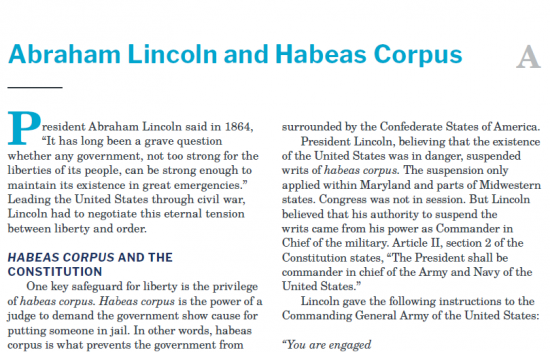
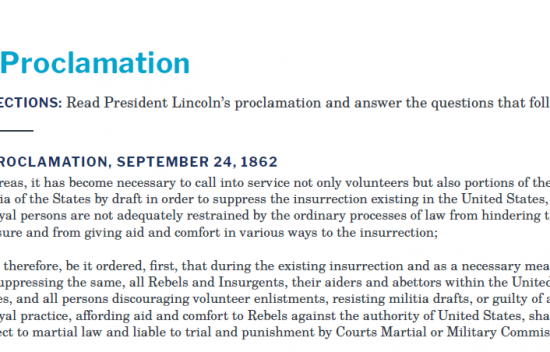
The “Great Writ” or habeas corpus has been an essential civil liberty guaranteed since Magna Carta. In listing powers denied to Congress, the Constitution notes that “The privilege of the writ of habeas corpus shall not be suspended, unless when in cases of rebellion or invasion the public safety may require it.” In 1861, Abraham Lincoln invoked this power of Congress—which was not in session—to suspend habeas corpus in certain areas. The next year, as he believed the civil justice system was inadequate to deal with the rebellion, he expanded the suspension throughout the United States and established military tribunals to try citizens charged with disloyalty. In this lesson, students explore Lincoln’s suspension of habeas corpus and constitutional issues surrounding it.
Founding Principles
Objectives:
Students will:
- Explore the events that led to President Lincoln’s suspension of habeas corpus.
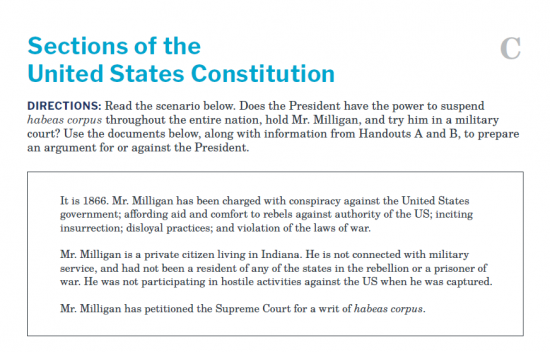
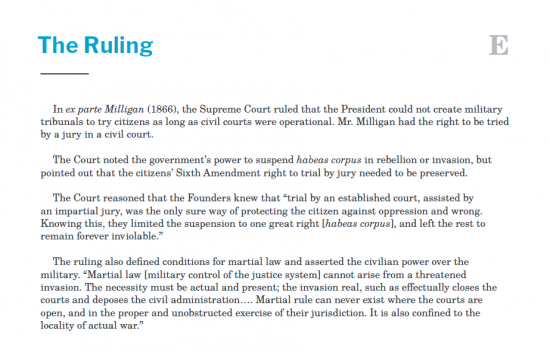
- Understand the Supreme Court cases ex parte Merryman and ex parte Milligan.
- Assess the constitutionality of Lincoln’s actions.
- Evaluate Lincoln’s attempt to balance liberty and security during the Civil War with his suspension of habeas corpus in certain areas and eventually the entire nation.
Materials
- Handout A: Abraham Lincoln and Habeas Corpus
- Handout B: A Proclamation
- Handout C: Sections of the United States Constitution
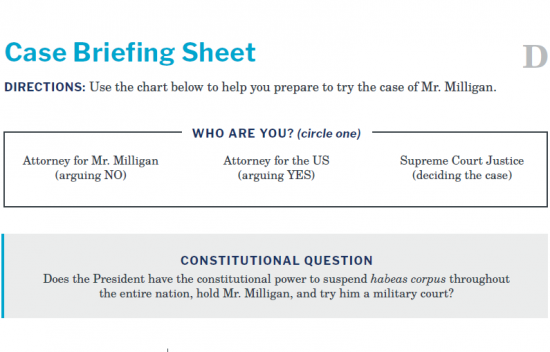
- Handout D: Case Briefing Sheet
- Handout E: The Ruling
Lesson Components
Lesson plan
50 minClick a phase to open it
More Information
To create a context for this lesson, have students complete Constitutional Connection: War and the Constitution.
Standards
Related materials

LessonDue Process and Fair Trials
Does the Supreme Court still have a responsibility to abide by fair trials, due process, and the Constitution during wartime? Evaluate the contradictory viewpoints concerning liberty and security.

E LessonHamdi v. Rumsfeld (2004)
Ten years ago, the Supreme Court ruled on a case involving enemy combatants, Hamdi v. Rumsfeld(2004). In this eLesson, students will explore this landmark case on the rights of the accused.