Lesson
Colonial Comparison: The Rights of Englishmen in the Colonial Era

Founding Principles
Natural/Inalienable Rights, Property Rights, Representative / Republican Government
Objectives:
- Students will be able to explain how the colonial charters reflected the traditional rights of Englishmen by analyzing four colonial charters.
- Students will be able to show how colonial charters reflect constitutional principles by comparing constitutional themes in four colonial charters.
Materials
Lesson Components
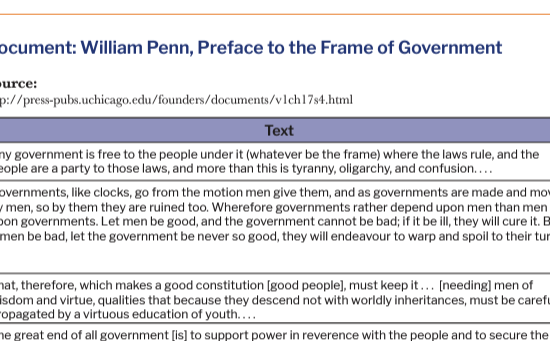
An excerpted primary source to introduce students to the theme of American identity that emerged in the Colonial Era.
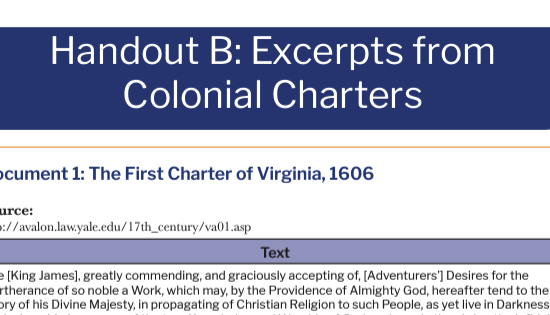
Four primary sources from the 1600's that showcase the Colonist's understanding of government.
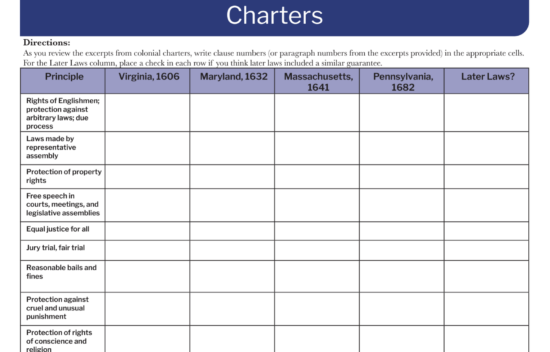
An activity to accompany the Excerpts of Colonial Charters primary sources. Aimed at helping students categorize the cultural values and political understanding in the English colonies.
Lesson plan
More Information
You might have students give specific references rather than just placing a check in the Later Laws column. For example, in the Jury Trial row, they would note the Sixth and Seventh Amendments to the U.S. Constitution. You might even make a competition out of this step and provide a prize (homework pass, and so forth) to the group that correctly completes this column first.)
Standards
Advanced Placement
- Topic 2.3 · The Regions of British Colonies
- Topic 2.7 · Colonial Society and Culture
- Theme · American and National Identity
- Theme · Geography and the Environment
- Learning Objective · Unit 2C
- Learning Objective · Unit 2I
- Historical Development · 2.1.II.E
- Historical Development · 2.2.I.D
- Reasoning Skill · Developments and Processes
- Reasoning Skill · Sourcing and Situation
- Reasoning Skill · Claims and Evidence in Sources
- Reasoning Skill · Contextualization
- Reasoning Skill · Making Connections
- Reasoning Skill · Argumentation
- Reasoning Process · Comparison
- Reasoning Process · Continuity and Change
Check whether this resource aligns with your state’s standards →
Related materials


How much did the colonists form their own American identity and how much of the identity of their mother country did they keep? Malcolm Gaskill and Phillip Hamilton debate this question.


Primary Sources and an introductory essay to help students dive deep into the ideas that create the American governmental system.

Early colonial culture helped create a distinct American identity based on self-reliance, political participation, and religious independence. Because Britain exercised limited control over the colonies, Americans developed their own economies, representative governments, and local institutions while still considering themselves loyal British subjects. Colonial society was generally more socially equal and politically engaged than England, with widespread literacy and active public debate. Religious movements such as Puritanism, the Great Awakening, and the growth of dissenting Protestant denominations encouraged individualism and challenges to established authority. Over time, these experiences fostered a unique American character that differed from Britain’s and laid the foundation for the colonists’ eventual push for independence.

In this episode, we will focus on topics from Colonial America that will be most useful for contextualizing later events in US History.