Lesson
John Marshall’s Landmark Cases DBQ

Objectives:
- Students will systematically analyze primary sources by answering targeted sourcing and comprehension questions for each document.
- Students will articulate the main contributions to constitutional interpretation of Chief Justice John Marshall by writing a thesis statement that responds to the following prompt: Evaluate the contributions to the power of the federal government by John Marshall as chief justice of the U.S. Supreme Court. OR, alternate prompt: To what extent does John Marshall deserve the title “The Great Chief”?
Materials
Lesson Components
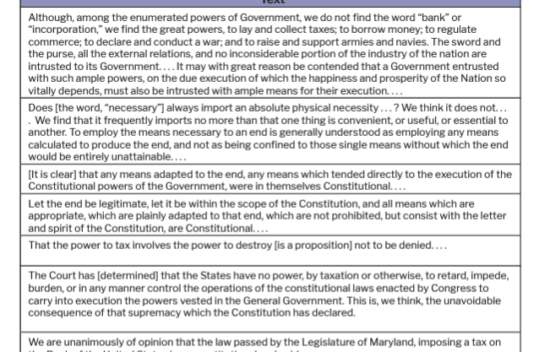
Four primary sources that help students explore the juris prudence of Chief Justice John Marshall in a DBQ format. This activity concludes with a thesis writing exercise.
Lesson plan
More Information
This DBQ builds on skills used in previous units.
Seven documents are used in this DBQ to prepare students for the APUSH Exam DBQ format. Teachers may choose to use the provided questions as scaffolds for students or remove them as best suits their teaching situation. The documents may be used in isolation or in combinations as the teacher sees fit.
It is recommended that, after the warm-up activity analyzing a few relevant constitutional passages, the teacher model the process of analyzing the landmark case excerpts by working through Document 1, Marbury v. Madison (1803) with the class as a whole, and then have students complete the remaining document analyses individually or in groups.
Standards
Advanced Placement
- Topic 4.2 · The Rise of Political Parties and the Era of Jefferson
- Theme · Politics and Power
- Learning Objective · Unit 4B
- Historical Development · 4.1.I.B
- Reasoning Skill · Sourcing and Situation
Check whether this resource aligns with your state’s standards →
Related materials


BRI staff members, Kirk Higgins and Rachel Davison Humphries were joined by special guests Dr. Joyce Lee Malcolm, Professor of Constitutional Law and the Second Amendment at the Antonin Scalia Law School at George Mason University and Jotwan Daniels, 2019 BRI Teacher Council Member and Master Educator from Breckenridge, CO, as they discuss the famous Supreme Court case Marbury v. Madison. They analyze the impact of the case and discuss pedagogy techniques in a rousing discussion.