Video
Early Republic Middle School Video
Watch
Founding Principles
Virtues
About this video
In this middle school lesson, students examine a political cartoon from 1807 to explore how the Constitution shaped decision-making in the early American Republic. Set during Napoleonic Wars, the lesson focuses on Thomas Jefferson and the controversial Embargo Act of 1807. As Britain and France interfered with American trade and practiced impressment, Jefferson and Congress faced constitutional questions about regulating commerce, separation of powers, and protecting national interests without going to war.
Through guided analysis, students practice the historical thinking skill of providing context, asking who, what, when, where, why, and how to better understand the cartoon’s message. They evaluate debates between Democratic-Republicans and Federalists, consider principles like separation of powers and consent of the governed, and craft a clear thesis answering the essential question: How did the Constitution influence decisions in the early Republic?
0:03 Welcome to the museum.
0:04 In the early years of the Republic, American leaders
0:07 were starting to apply the constitution to real world problems.
0:11 One of those problems came during President Thomas Jefferson’s
0:15 administration, when European powers kept interfering with American trade.
0:20 Today, we’ll look at a political cartoon from 1807 about Jefferson’s role
0:25 and America’s response to these European powers with an economic embargo.
0:30 That’s right.
0:31 Both Britain and France were seizing American ships during the Napoleonic Wars.
0:35 American leaders like Jefferson had to decide how to respond.
0:39 As we examine the political cartoon, we’ll ask,
0:42 how did the Constitution influence decisions in the early Republic?
0:46 And we’ll practice the BBC’s skill of providing context,
0:50 understanding the background that shaped the choices leaders made.
0:54 Let’s take a closer look at this cartoon on the surface.
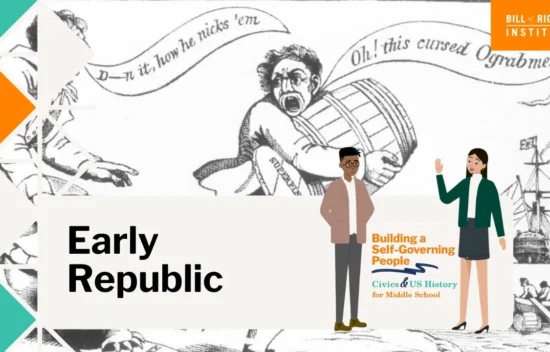
0:58 This cartoon seems like a silly image of a snapping turtle biting at a man
1:02 holding a barrel.
1:03 But there’s so much more to it than that.
1:06 This cartoon shows
1:07 a man egging on a snapping turtle called, oh, grab me!
1:11 That’s embargo spelled backwards.
1:14 He has a speech bubble that reads, darn it.
1:17 How he nixed them.
1:18 The turtle is fighting a merchant who’s trying to carry a barrel of goods
1:22 to a boat on shore.
1:24 He says, oh, this curse.
1:26 Don’t grab me.
1:28 The barrel reads super fine,
1:30 indicating that these barrels are full of flour.
1:33 The turtle stands on an official looking document that does license
1:38 in the background.
1:39 Ships sit at sea waving the British flag.
1:42 The cartoonist is criticizing Jefferson’s Embargo Act of 1807,
1:47 which was deeply unpopular, especially in New England,
1:52 but that isn’t immediately clear by just looking at the cartoon.
1:56 We have to understand more about the context
1:59 or the world around the cartoon to understand what is trying to say
2:03 and what it can tell us about
2:04 how the Constitution was influencing decisions in the early Republic.
2:23 Now let’s think like historians and practice the duck
2:27 skill of providing context.
2:30 Providing context.
2:31 It’s the who, what, when, where, why, and how of the document.
2:36 Context explains the world around the source, helping the viewer
2:40 understand the significance of the source within the time period.
2:44 In this case, Jefferson’s embargo didn’t happen in isolation.
2:48 It was part of a much bigger picture.
2:52 That’s right across the Atlantic.
2:54 Britain and France were at war.
2:56 This set of conflicts was called the Napoleonic Wars.
3:00 Both France and Great Britain wanted to stop
3:03 the United States from trading with the other side.
3:06 British ships were even seizing American sailors
3:09 and forcing them into service in the British Navy.
3:12 This is called impressment because the sailors were being pressed
3:16 into service.
3:18 We can add this to our context organizer under Main Events before,
3:24 let’s write
3:24 Napoleonic Wars in Europe and impressment of U.S.
3:28 sailors at home.
3:30 Jefferson faced a challenge about how to approach this problem.
3:35 His job as the president was outlined in the Constitution,
3:39 which states the rules for what each branch of government can and can’t do.
3:45 He wanted to prevent American sailors
3:47 from impressment and protect American trade.
3:51 And he didn’t want America to go to war on either
3:54 side of the European conflict, but to take action.
3:58 He couldn’t act alone.
4:01 A president can sign a law,
4:03 but Congress, the legislative branch, has to pass it first.
4:07 The Constitution gives Congress the authority to pass laws
4:10 which regulate commerce with foreign nations.
4:13 And that’s exactly what the Embargo Act, which Jefferson favored,
4:16 was looking to do.
4:18 We can write constitutional questions
4:21 and a number one with separation of powers.
4:25 The story doesn’t end there.
4:27 Some Americans, like the Federalists who oppose Jefferson’s party, argue
4:32 that the embargo against all foreign trade stretched government power too far.
4:38 The Federalists were mostly located in New England,
4:41 where the Embargo Act took the biggest toll.
4:45 They thought the act was too harmful to the economy and the common good,
4:49 and that it was passed for political reasons, not to protect national security.
4:55 This can bring us to our next constitutional question.
4:58 For number two, let’s add consent
5:00 of the governed by looking at this context.
5:04 We can see how the Constitution states the powers of each branch.
5:08 But there can still be disagreement about what each branch
5:11 can do and about what’s best for the country.
5:14 Let’s return to our big historical question.
5:17 How did the Constitution influence decisions in the early Republic?
5:21 We can use what we recorded on our organizer to formulate
5:24 a thesis using the context we learned through the cartoon.
5:28 Like this.
5:29 The Constitution guide leaders as they faced challenges
5:32 like the impressment of American sailors by Britain and France, for example.
5:37 They passed the Embargo Act to respond to these problems.
5:40 Leaders had to make tough and unpopular choices
5:43 while following key principles in the Constitution,
5:45 such as separation of powers and consent of the governed.
5:50 The embargo did not work as Jefferson hoped.
5:53 In fact, history now remembers the Embargo Act as an utter failure
5:58 because it ruined American trade and the economy.
6:02 But it shows us how early presidents had to walk a line
6:06 between what they wanted to do and what they were allowed to do
6:09 under the Constitution, all while protecting national interests.
6:14 And by providing context.
6:17 Looking at international tensions, Jefferson’s actions and constitutional
6:21 limits, we can better understand why he chose this path.
6:25 So next time you study a historical document
6:28 or image, remember the story around it.
6:31 The context is what makes its meaning come to life.
Standards
Related Resources
How did the Constitution influence decisions in the Early Republic?

Help students provide historical context for primary source documents in a deconstructed DBQ.

This nine-unit U.S. history and civics curriculum empowers middle school students to explore how Americans have worked to create and sustain a self-governing, free society.