Video
The Colonial World Middle School Video
Watch
Founding Principles
Consent of the Governed, Democracy, Majority Rule/Minority Rights
Virtues
About this video
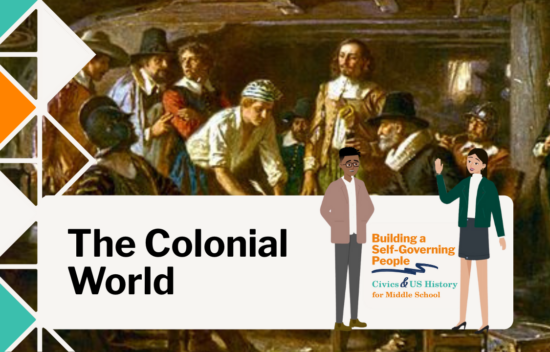
In this middle school history lesson, travel back to 1620 to examine how early American colonists took their first steps toward self-government. Using the painting Mayflower Compact 1620 by John Leon Jerome Ferris, students explore how pilgrims and other settlers aboard the Mayflower created a social contract that laid the foundation for democratic rule in the New World.
How did different groups in the American colonies establish and practice self-government? Through guided historical thinking, students begin to craft a thesis and support it with reasoning, key skills they'll apply in the unit’s scaffolded Document-Based Question (DBQ) assessment.
0:03 Welcome to the museum. Today we’re stepping back in time to 1620 aboard the Mayflower. The image we are looking at today is called Mayflower Compact 1620. It’s an oil painting by an American painter named Jean Leon Jerome Ferris created in 1932. >> This piece will give us great information to answer our historical question. How did different groups such
0:25 as religious communities, traders, and settlers in the American colonies establish and practice self-government through the context of one important group, settlers on the Mayflower? >> Right? This scene shows a pivotal moment, the signing of the Mayflower Compact. We know this from the title of the painting. But why was this moment so important? The Mayflower carried a group
0:46 of settlers, many seeking religious freedom and others drawn by opportunity. They intended to land in the colony of Virginia, but arrived much farther north. They knew that as soon as they stepped off the ship, they would be outside of the reach of British law. Before they even set foot on land, they faced a big question. How would they govern themselves in this new world?
1:07 This was an important question because they faced many dangers and many unknowns, settling thousands of miles from their homes, and needed to stick together to make it work. The Mayflower Compact was their answer. It was a promise between the settlers, a social contract, that they would work together and follow laws for the good of the colony. This was one of the earliest
1:27 forms of self-government in what would become the United States. Now, let’s take a closer look at this painting by breaking down some of its elements. Here, we see people in a variety of clothing. This specific outfit is well known as the clothing of the Pilgrims, a group of religious separatists from England. They left England for Holland and then for the American colonies in the 1600s.
1:51 The pilgrims aimed to create a pure society that followed their religious and social customs, including the simple modest clothing. What’s on the table here? It looks like a document. This character is holding a pen or quill and is writing, perhaps even signing the document. Everyone in the image looks very intentional, focused, and serious.
2:12 The artist is showing us that this is an important moment through these faces and the use of dark, deep colors and shadows. So there you have it. Jean Leon Jerome Ferris’s painting of the signing of the Mayflower Compact shows us how one group established and practiced self-government in the colonial era. >> That’s right. Now that we have an understanding of the art, the artist,
2:34 and the historical significance, let’s take this idea further back in the classroom. So let’s return to our historical question. How did different groups such
2:55 as religious communities, traders, and settlers in the American colonies establish and practice self-government? With our understanding of the historical significance of the Mayflower compact from the painting, we can use that knowledge to answer this important historical question. But to answer the question, we need a strong thesis. A thesis is a one or two
3:16 sentence answer to the question that clearly states our argument. It is a claim plus a line of reasoning. Let’s build one together. To do this, we need to understand the question. The question mentions different groups and gives us a few examples. Establish means to set up and self-government means government by the people and for the people who
3:37 created. We know that one group, the pilgrims, created a system of self-government by signing the Mayflower compact even before they left the ship. This shows that self-government was a priority from the very beginning. So, we could answer this question by saying one way colonists established self-government was through the Mayflower Compact.
3:59 But we can make this stronger. Let’s be more specific and use more language from our question to be sure we are answering it clearly. How about colonists established self-government through the signing of the Mayflower Compact before setting foot on land? See, this thesis clearly connects the action signing the compact to the
4:20 concept of self-government. And just like that, we’ve created a solid historical argument. >> The idea of self-government isn’t just something from the past, it’s something you experience all the time. >> Yeah. Just like the pilgrims had to create their own system of rules to survive in a new world, you and your classmates make decisions about how to
4:41 work together every day. Whether it’s working on a group project or playing on a team, self-government is still a part of life today, even if you don’t sign a compact. >> The Mayflower Compact was an early step toward democracy in America. By studying how different groups practice self-government in the past, we can see how we can be active participants in
5:02 shaping our communities today.
Guiding Question:
In what ways did different groups in the American colonies establish and practice self-government?
About the Video Series:
Our video resources in the Building a Self-Governing People middle school curriculum integrate primary source analysis with Document-Based Question (DBQ) skills to deepen student learning. Use them to launch your assessment lesson or to support students who need a refresher on DBQ strategies.
Each video features two young professionals: a museum curator leading a gallery tour and an educator accompanying students on a field trip. The curator models how to analyze primary sources such as historical documents and artwork. Then, the educator demonstrates how to use that analysis to answer a compelling historical question.
For guidance on how to use the videos within your lessons, refer to the unit’s Deconstructed DBQ Lesson Plans.
Discussion Questions:
If you are using the video as a standalone resource, consider using the following questions to guide student inquiry or spark class discussion.
- What does this primary source tell us about the time period in which it was created?
- Why do you think the creator made this source? What message were they trying to send?
- How does this source connect to the larger theme of self-government, rights, or civic participation?
- Who is represented in the source—and who is missing? Why might that matter?
- What surprised you or challenged what you thought you knew about this topic?
- How did the educator use the source to build a thesis? Could you restate their thesis in your own words?
- What clues did the educator or curator use to analyze the source? How could you use those in your own writing?
- Why is grouping documents important when answering a DBQ question? How might you group the sources shown in the video?
- What background information (context) helped make the source more understandable or meaningful?
- If you had to answer the DBQ question yourself, what would your claim be—and what evidence from the video would you use?
Standards
Related Resources

In what ways did different groups, such as religious communities, traders, and settlers in the American colonies establish and practice self-government?

What were the challenges faced by early settlers, how did colonial societies develop, and what role did the growing tensions with Britain play?

This nine-unit U.S. history and civics curriculum empowers middle school students to explore how Americans have worked to create and sustain a self-governing, free society.