Lesson
Rights and Responsibilities
Guiding question
What is a right?

Founding Principles
Guiding Questions
- What is a right?
- What is a responsibility?
- What responsibilities are natural byproducts of the rights we enjoy?
- How does exercising our rights and fulfilling our responsibilities help to promote the common good for all?
Objectives
- Students will differentiate rights from responsibilities.
- Students will analyze the relationship between rights and responsibilities.
- Students will explain how rights and responsibilities are related to the common good.
Materials
Lesson Components
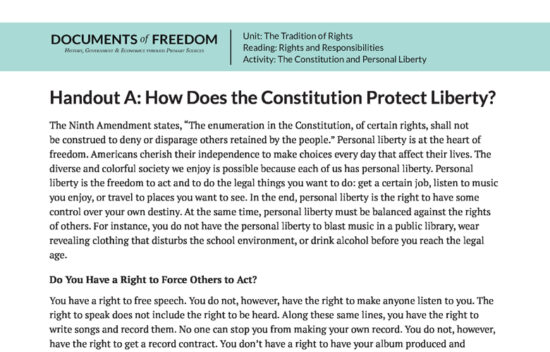

What many today might call “rights,” such as federally-guaranteed social security payments, disability payments, food stamps, education, a minimum wage, and health care, the Founders would not have seen as rights. Even today, these benefits are more rightly called “entitlements.” This difference does not mean that entitlements are better or worse, but calling them “rights” can be dangerous. In addition to the shift from rights to entitlements, another evolution in the tradition of rights has to do with individual responsibility. Part of living in a society with self-government on a societal level is self-government on an individual level.
Lesson plan
Key Terms
- rights
- responsibilities
- common good
Standards
Related materials

The Constitution was written in the summer of 1787 in Philadelphia, Pennsylvania, by delegates from 12 states, in order to replace the Articles of Confederation with a new form of government. It created a federal system with a national government composed of 3 separated powers, and included both reserved and concurrent powers of states.