Curriculum
Documents of Freedom
Essential Question
What was the Founding vision for American government and what is the story of the on-going struggle to achieve it?

Units

In this introductory unit, students will be given an overview of the entire course as well as an introduction to Founding principles and virtues necessary for a successful constitutional republic.

America's Founders looked to the lessons of human nature and history to determine how best to structure a government that would promote liberty. They started with the principle of consent of the governed: the only legitimate government is one which the people themselves have authorized. But the Founders also guarded against the tendency of those in power to abuse their authority, and structured a government whose power is limited and divided in complex ways to prevent a concentration of power. They counted on citizens to live out virtues like justice, honesty, respect, humility, and responsibility.

The structural or institutional features of the American constitutional order only make sense in the context of what the Founders hoped to achieve--securing the right of the American people to live decent, worthwhile lives according to their own goals and faculties. The thoughtful preservation of those institutions, occasionally through necessary corrective measures, depends on a proper understanding of what it is that they are designed to promote as well as an appreciation of how to manage those institutions to serve the best interests of the American people. All of this requires a citizenry with the skills and dispositions necessary for republican self-government, that is, a citizen body whose members understand and act to promote justice.

Rights claims have always been central to American political discourse. In the Founders' view, no human being is so decisively superior to other adult human beings that he is entitled to direct their actions without their express consent. By Nature all adult human beings, regardless of their race, sex or class, are free to rule themselves or, what is the same, to exercise the same "inalienable rights," including the right to life, physical liberty, acquire and use property, marry and raise children, communicate one's opinions, and worship God according to the dictates of one's conscience.

In this unit, students will learn about the struggles for liberty and equality throughout American history.

During the War of Independence, British North Americans expanded the principles of federalism and separation of powers by being among the first Europeans to codify their practices in written constitutions. Several colonial charters and their subsequent revisions established a practice of protecting the interests of towns, villages, and communities by securing their economic interests as well as their participation in colonial governments.

The evidence seems overwhelming that free enterprise and widespread economic prosperity are more than just connected; the first leads directly to the second, not just in America but around the world.

Our commercial republic is rooted in the ideas of John Locke and Adam Smith.
Curriculum resources

The United States Founders believed that certain civic virtues were required of citizens in order for the Constitution to work. Numerous primary sources—notably the Federalist Papers and the Autobiography of Ben Franklin—point us to the “Founders’ Virtues.” Before exploring the Documents of Freedom, it is important to understand civic virtue as an essential element of self-government.

Primary sources are a main focus throughout Documents of Freedom. Here we offer many of the most important primary sources from American history that include annotations to help you understand the purposes of each document.

The Declaration of Independence was drafted by Thomas Jefferson in June of 1776. The Declaration announced to the world that the thirteen American colonies regarded themselves independent sovereign states. It articulates the fundamental ideas that form the American Nation: All people are created free and equal and possess the same inherent, unalienable rights. This lesson plan includes six activities. The activities can be taught in sequence as a comprehensive overview of the Declaration of Independence or individual activities can be taught as stand-alone lessons.

What were the Founders’ concepts of justice, liberty, and rights and where did those concepts came from? How have these ideas changed over time? Use these primary sources to analyze.

In 1787, many Americans were concerned that the Articles of Confederation did not grant enough power to the central government to protect the rights of the people. Under the Articles, the national government was unable to regulate commerce, taxation, currency, treaties, and protect the rights of individuals and states. The states called a delegation to meet in Philadelphia in the summer of 1787 and from that convention the new Constitution was born.

All humans are born with equal inherent rights, but many governments do not protect people's freedom to exercise those rights. The way to secure inalienable rights, the Founders believed, was to consent to giving up a small amount of our freedom so that government has the authority to protect our rights. Freedom depends on citizens having the wisdom, courage, and sense of justice necessary to take action in choosing virtuous leaders, and in holding those leaders to their commitments.

The Founders believed that the government’s authority needed to come from the people. Under the reign of King George III, the colonists believed that they were deprived of their opportunity to consent to be governed by Parliament through representatives, and, therefore, the British could not force their laws upon the colonies. The Founders made sure to uphold this right in the American Constitution. The people, through their representatives at state ratification conventions, had to ratify the document in order for it to become law.
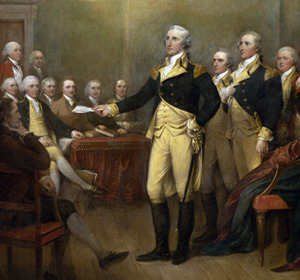
The benefits of freedom are safest when officials cannot make arbitrary and unpredictable laws. The rule of law means that laws are stable, limited in scope, and applied to every citizen, including those who make them. Laws must be created in the open, according to clear rules, and must reflect the consent of the governed. Ultimately, the rule of law depends on people with the courage, self-reliance, and wisdom to make prudent decisions, and who have enough tolerance for others to let them live as they see fit.

The Framers of the U.S. Constitution knew that the new government they crafted must be more powerful and effective than the government under the Articles of Confederation. They studied history and human nature to create a government strong enough to promote the public good, but not so strong that it would become a threat to individual liberties.

The Founders understood the principle expressed by the British historian, Lord Acton, “All power tends to corrupt; absolute power corrupts absolutely.” Through the complex system of checks and balances developed in the U.S. Constitution, they sought to assure that no person or branch of government could exercise unrestrained power. As James Madison advocated in Federalist No. 51, ambition should counteract ambition in a fashion that advances the public good.

While many people today use the terms “republic” and “democracy” interchangeably, America’s Founders saw important differences between the two forms of government. Distrustful of democracies, they were skeptical about the protection of individual rights in a system that functioned simply by majority rule. The Framers of the United States Constitution instead crafted a constitutional republic based on majority rule but included structures to curb its excesses and protect essential liberty interests.

The principle of due process of law means that the government must follow duly-enacted laws when it seeks to restrict or deny fundamental rights, including a person’s rights to life, liberty, or property. In essence, it means that the government must treat its citizens fairly, following laws and established procedures in everything it does. It is the commitment to this principle that makes the United States, as John Adams once noted, “a government of laws, and not of men.”
Standards
Related curricula

How do the Founding documents connect to our civic values and the fundamental right of citizenship?

How did the Founders intend the legislative branch of government to operate? Through primary source analysis and engaging activities, examine the purpose of a legislature, the design of the U.S Congress, its powers, its history and the reality of how Congress works today with your students through these lessons.

Preserving the Bill of Rights teaches students Constitutional principles by examining primary source documents and significant Supreme Court cases. In addition, each unit features expanded classroom activities engaging students with the Bill of Rights and the responsibilities of citizenship. Students will understand the connection between current events and the Bill of Rights when they participate in activities such as writing letters to their elected representatives; serving in a mock jury; creating public service announcements; and writing model laws.