Lesson
Due Process of Law

Founding Principles
Guiding Questions
- What are some specific elements of due process in criminal cases, and what are the landmark cases by which the Supreme Court interpreted and affirmed those protections?
Objectives
- Students will comprehend elements of due process protected by the U.S. Constitution.
- Students will analyze four landmark cases as examples of due process protections.
Materials
Student Handouts:
- Due Process of Law Introductory Essay
- Handout A: Rights of the Accused Essay
- Handout B: Due Process Amendments
- Handout C: Mapp v. Ohio (1961)
- Handout D: Gideon v. Wainwright (1963)
- Handout E: Miranda v. Arizona (1966)
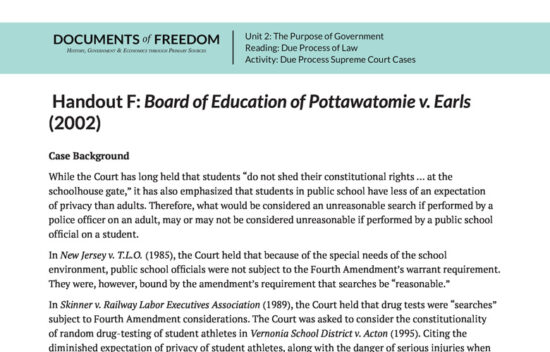
- Handout F: Board of Education of Pottawatomie v. Earls (2002)
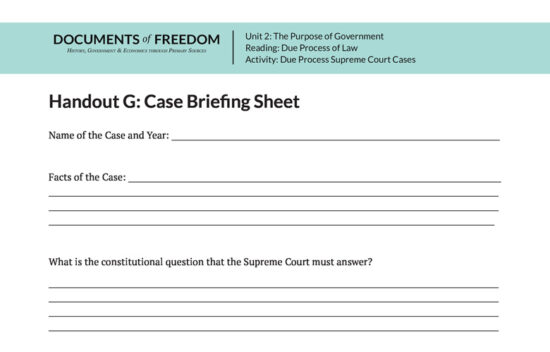
- Handout G: Case Briefing Sheet
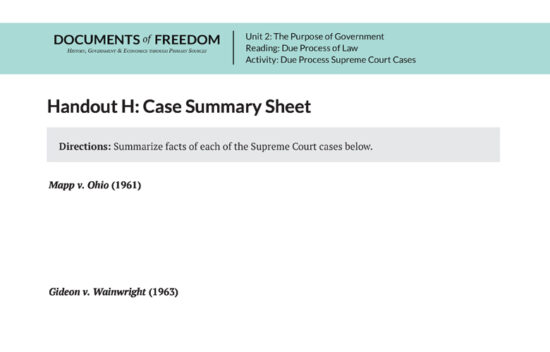
- Handout H: Case Summary Sheet
Lesson Components

The principle of due process of law means that the government must follow duly-enacted laws when it seeks to restrict or deny fundamental rights, including a person’s rights to life, liberty, or property. In essence, it means that government must treat its citizens fairly, following laws and established procedures in everything it does. It is the commitment to this principle that makes the United States, as John Adams once noted, “a government of laws, and not of men.”
Lesson plan
Key Terms
- Bill of Rights
- Sixth Amendment
- Eighth Amendment
- due process
- republic
Standards
Related materials

How has the Supreme Court interpreted rights concerning criminal procedure, search and seizure, and due process? Explore these landmark Supreme Court cases to find out.

Due process is a fundamental constitutional guarantee of the United States justice system, and a principle discussed recently in the news in relation to several high-profile cases springing from Special Counsel Robert Mueller’s investigation of Russian interference with the 2016 presidential election. It is a right of the accused that the accuser must adhere to as they seek to prove the guilt or innocence of an aggrieved party.

Do you ever feel like all eyes are on you? You may be right! This suite of all-new resources will help you teach your students about the principle of Due Process. In addition, your students will apply this and other principles to understand the Fourth Amendment, expectations of privacy, and landmark Supreme Court cases.