Lesson
Equal and Inalienable Rights
Guiding question
What are inalienable rights?

All humans are born with equal inherent rights, but many governments do not protect people's freedom to exercise those rights. The way to secure inalienable rights, the Founders believed, was to consent to giving up a small amount of our freedom so that government has the authority to protect our rights. Freedom depends on citizens having the wisdom, courage, and sense of justice necessary to take action in choosing virtuous leaders, and in holding those leaders to their commitments.
Founding Principles
Guiding Questions
- What are inalienable rights?
- What is the role of government in protecting natural rights?
- How did the Founders view liberty, justice, natural rights, and consent of the governed?
Objectives
- Students will analyze primary sources on the social contract theory: Hobbes’s The Leviathan, Locke’s Second Treatise of Civil Government, and the Declaration of Independence.
- Students will compare and contrast Hobbes and Locke.
Materials
Student Handouts & Materials
- Equal and Inalienable Rights Essay
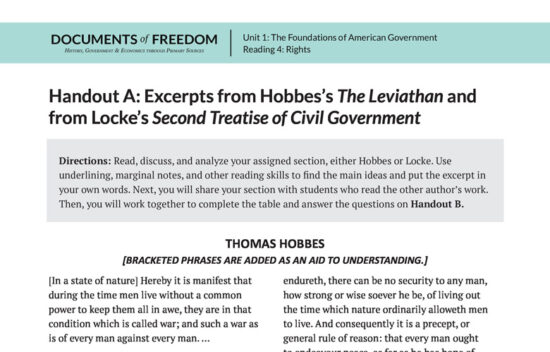
- Handout A: Excerpts from Hobbes’s The Leviathan and from Locke’s Second Treatise of Civil Government
- Handout B: Comparing and Contrasting Hobbes and Locke
- 3 large classroom chart paper (for group work with markers)
Lesson Components

EssayEssay: Equal and Inalienable Rights
All humans are born with equal inherent rights, but many governments do not protect people's freedom to exercise those rights. The way to secure inalienable rights, the Founders believed, was to consent to giving up a small amount of our freedom so that government has the authority to protect our rights. Freedom depends on citizens having the wisdom, courage, and sense of justice necessary to take action in choosing virtuous leaders, and in holding those leaders to their commitments.
Lesson plan
Click a phase to open it
Key Terms
- liberty
- justice
- natural rights
- Magna Carta
- tyranny