Lesson
Andrew Johnson and the Civil War Amendments
Guiding question
How did President Andrew Johnson interpret the Constitution with respect to restoring the Union after the Civil War?

Objectives:
Students will:
- Trace the constitutional controversies of Andrew Johnson’s presidency.
- Understand Johnson’s constitutional objections to the Fourteenth Amendment and other elements of Reconstruction.
- Evaluate Johnson’s understanding of the Constitution.
Materials
- Handout A: Andrew Johnson and the Civil War Amendments
- Handout B: Johnson’s First Annual Message to Congress, December 1865
Lesson Components
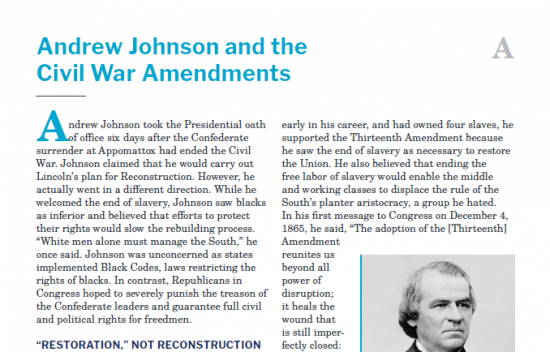
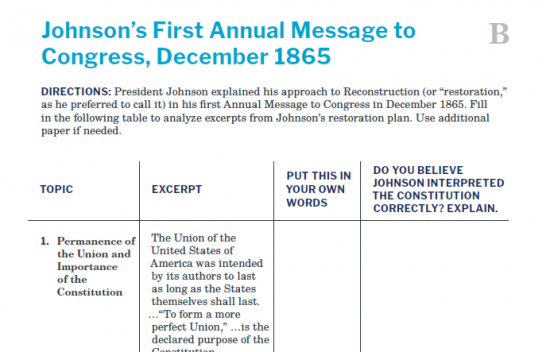
Lesson plan
More Information
To create a context for this lesson, have students complete Constitutional Connection: Slavery and the Constitution.
Standards
Related materials

The interests of Northern and Southern states grew increasingly divergent. Eleven states eventually seceded from the Union and formed the Confederate States of America. After the Civil War, Congress required that the southern states would approve the Thirteenth, Fourteenth, and Fifteenth amendments as a condition of their re-entry into the union. The Thirteenth Amendment banned slavery throughout the United States. The Fourteenth Amendment granted citizenship to formerly enslaved people and banned states from passing laws that denied the privileges and immunities of citizens, due process, or equal protection of the law. The Fifteenth Amendment extended the right to vote to black men. The Fourteenth Amendment in particular was a dramatic departure from the Founders’ Constitution, and set the stage for dramatic increases in the size, scope, and power of the national government decades later.

Explore the impact the Civil War amendments had on African-Americans during Reconstruction and beyond.

BRI staff members Kirk Higgins and Rachel Davison Humphries are joined by BRI Teacher Council member Michael Sandstrom and LeeAnna Keith, author of "The Colfax Massacre: The Untold Story of Black Power, White Terror, and the Death of Reconstruction," as they explore meaningful narratives from the Reconstruction time period and their implications today. What role did the Reconstruction amendments, the 13th Amendment, 14th Amendment, and 15th Amendment play in local, state, and federal outcomes of the onset of the Jim Crow?

The Civil War and Reconstruction period produced significant political, economic, and social transformations in the United States, but for African Americans the progress had mixed results at best. The legacy of the Civil War included the central question of what emancipation meant beyond the destruction of the institution of slavery.