Lesson
Changing Views of Slavery Mini-DBQ

Objectives:
- Students will be able to identify how attitudes toward African slavery in the United States have changed from the Founding Era to the mid-nineteenth century by a comparison reading of Thomas Jefferson’s Query XVIII from Notes on the State of Virginia (1781), Jefferson’s letter to Bishop Henri Gregoire (1809), David Walker’sAn Appeal to the Coloured Citizens of the World (1829), Sarah Moore Grimke’s “An Epistle to the Clergy of the Southern States” (1836), and William Harper’s essay “Slavery in Light of Social Ethics” (1837).
- Students will analyze primary source documents by answering comprehension questions to guide them to conclusions about the arguments being presented within them.
- Students will practice writing a thesis statement for a CCOT essay.
Materials
Documents included:
- Document 1: The Declaration of Independence (1776)
- Document 2: Thomas Jefferson’s Query XVIII from Notes on the State of Virginia (1781)
- Document 3: Thomas Jefferson’s letter to Bishop Henri Grégoire (1809)
- Document 4: David Walker’s An Appeal to the Coloured Citizens of the World (1829)
- Document 5: Sarah Moore Grimké’s “An Epistle to the Clergy of the Southern States” (1836)
- Document 6: William Harper’s essay “Slavery in Light of Social Ethics” (1837)
Lesson Components
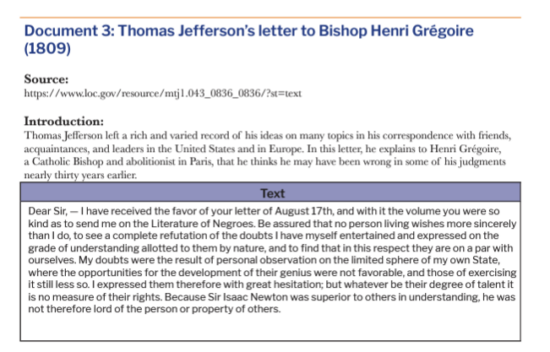
Six primary sources that help students explore the changing views on slavery as the 19th century progressed in a DBQ format.
Lesson plan
More Information
This lesson should follow exploration of the expansion of slavery due to the invention of the cotton gin. This lesson seeks to put into context the fundamental shift in thinking about slavery that occurred in the minds of observers of slavery as a result of its mass expansion during the early to mid-nineteenth century. Students should have the sensitivity and respect required to talk about the topic of slavery.
Standards
Related materials

Dr. Nicholas Cole, Senior Research Fellow at Pembroke College, University of Oxford and lead designer on the Quill Project, discusses the difficult issues of compromise during the Constitutional Convention.

What were Thomas Jefferson’s complex views and actions on slavery as statesman and slaveholder? In this episode of Scholar Talks, Cara Rogers Steven, Associate Professor of History at Ashland University, joins BRI Senior Fellow Tony Williams to discuss her first book, Thomas Jefferson and the Fight Against Slavery, published by the University Press of Kansas in the esteemed American Political Thought Series. This episode delves into Thomas Jefferson's education, his early anti-slavery writings, the complexities in Notes on the State of Virginia, his educational influence on republican government, and his actions as a statesman and slaveholder.

How did the abolitionist movement inspire the women’s suffrage movement? In this episode of BRIdge From The Past, Mary examines Benjamin Robert Haydon’s 1841 painting “The Anti-Slavery Society Convention.” Held in 1840, more than 300 people, mostly from Britain and the United States, attended the World Anti-Slavery Convention in London, including Elizabeth Cady Stanton and Lucretia Mott. What troubles arose for these women when trying to attend this abolitionist convention? How did the events of this convention lead to both an end of slavery in the United States and a beginning of suffrage for women?