Lesson
The Commerce Clause and the Expanding Powers of Congress

Founding Principles
Objectives
- Students will explain how the powers of Congress have changed over time especially due to changing understandings of the Commerce Clause of Article I, Section 8.
- Students will understand the role of the Supreme Court in broadly interpreting the Commerce Clause to expand the legislative powers of Congress and to allow Congress to delegate regulatory authority to the executive branch during and after the New Deal.
- Students will analyze the differences in length and complexity of language between laws written before 1900 and recent laws.
Materials
Student Handouts
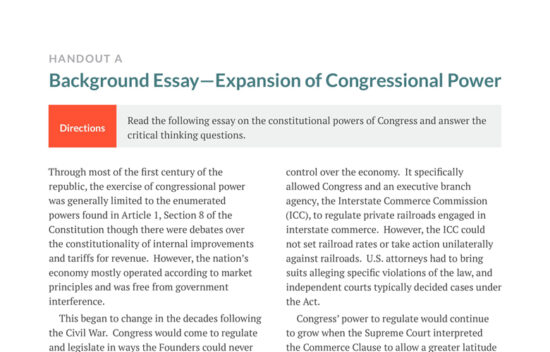
- Handout A: Background Essay – The Commerce Clause and the Expanding Powers of Congress
- Handout B: Timeline of Changing Commerce Powers of Congress
- Handout C: Article I, Section 8 of the U.S. Constitution
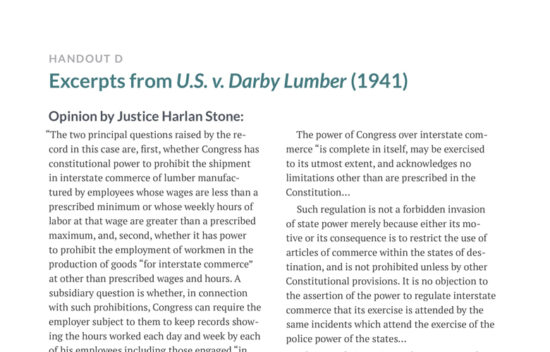
- Handout D: Excerpts from U.S. v. Darby Lumber (1941)
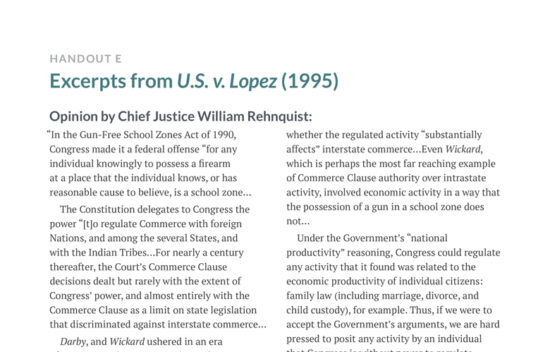
- Handout E: Excerpts from U.S. v. Lopez (1995)
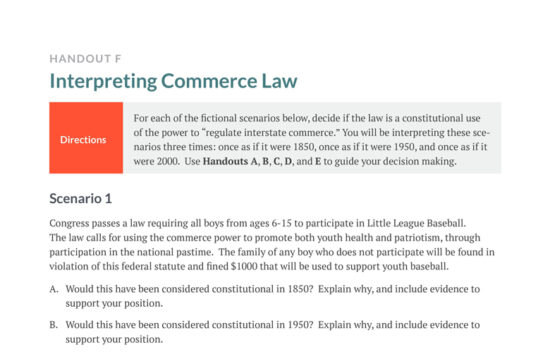
- Handout F: Interpreting Commerce Laws
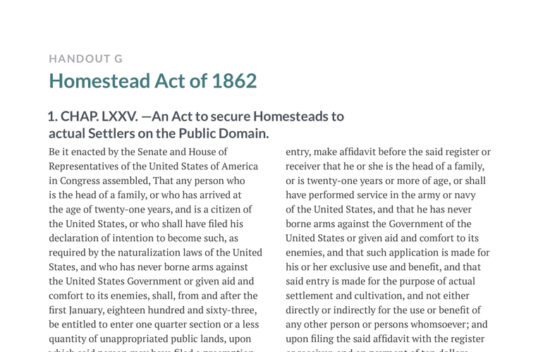
- Handout G: Homestead Act of 1862
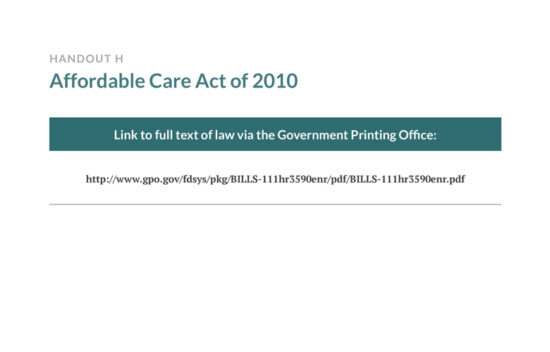
- Handout H: Affordable Care Act of 2010
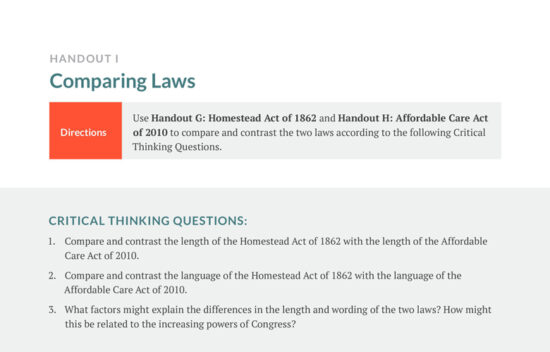
- Handout I: Comparing Laws
Teacher Resources
Lesson Components


Lesson plan
Key Terms
- Enumerated powers
- Commerce Clause
- Interstate commerce
- Legislation
- Laissez-faire
Standards
Related materials

Congress' power to regulate interstate commerce, granted in the Commerce Clause, is often invoked as justification for laws regulating a wide variety of economic activities. How much power does the Commerce Clause allow the federal government to have over the states? This lesson examines this question by looking at the principle behind this clause, the Founders intentions, and how the Supreme Court has interpreted the clause throughout American History.

This Homework Help narrative explores the landmark case of U.S. v. Lopez and its lasting impact on federalism. Students will study the topic of federal power and street crime while forming their own opinions on the merits of the case.

How does the Commerce Clause relate to gun regulation? To accompany our recently released U.S. v. Lopez Homework Help video, Tony and Josh break down opinions from the Supreme Court case itself, exploring how the majority and dissenting opinions tackled the relationship between education and commerce after a student brought a gun to school. What lasting impact did this case have on federalism?