Lesson
Gerrymandering, Representation, and Consent of the Governed
Guiding question
What does it mean to be represented in a self-governing republic?

What is the relationship between gerrymandering, the concept of representation, and the principle of consent of the governed?
Guiding Questions:
- What does it mean to be represented in a self-governing republic?
- How does representation support the Founding principle of consent of the governed?
- How does gerrymandering affect representatives’ ability to represent the needs of their constituents and the people?
Objectives:
Students will:
- Define the principle of consent of the governed and the concept of gerrymandering.
- Assess how gerrymandering affects representation in a republic.
- Summarize and assess how Supreme Court decisions in Baker v. Carr (1962) and Shaw v. Reno (1993) have added to the debates on gerrymandering, representation, and consent of the governed.
Materials
Student Handouts
- Primary Source Documents
- “The Gerry Mander,” Boston Centinel, 1812
- Baker v. Carr (1962) majority and dissenting opinions
- Shaw v. Reno (1993) majority and dissenting opinions
- Graphic Organizer
Lesson Components

ActivityGerrymandering Primary Sources
Three primary sources that explore the concepts of gerrymandering and redistricting.
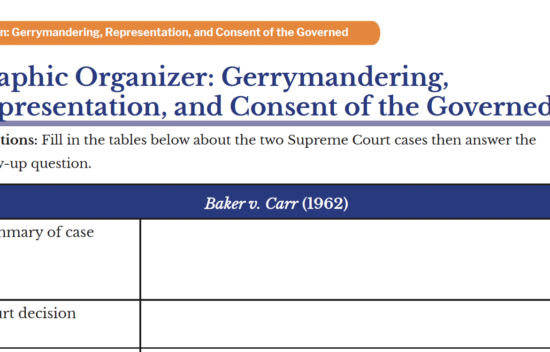
ActivityGerrymandering, Representation, and Consent of the Governed Graphic Organizer
Questions to help students see the representative government questions in Baker v. Carr (1962) and Shaw v. Reno (1993).
Lesson plan
Click a phase to open it
Key Terms
- Consent of the governed
- the power of government comes from the people.
More Information
This lesson looks at the concept of gerrymandering and how that process leads to debates over consent of the governed and representation. Students will review political cartoons and the key ideas of Baker v. Carr (1962) and Shaw v. Reno (1993), two cases that are required by the AP U.S. Government and Politics course.
Standards
Related materials

E LessonGerrymandering, Representation, and the Consent of the Governed
Does gerrymandering support the concept of representation and consent of the governed?