Lesson
James Madison and the Bonus Bill
Guiding question
What was President James Madison’s view of federal power?

Founding Principles
Objectives:
Students will:
- Understand James Madison’s view of federal power.
- Understand Madison’s reasons for viewing unlimited federal power as a threat to liberty.
- Apply Madison’s reasoning to determine how he would have assessed the constitutionality of federal laws.
- Appreciate Madison’s contributions to limited government and liberty.
Materials
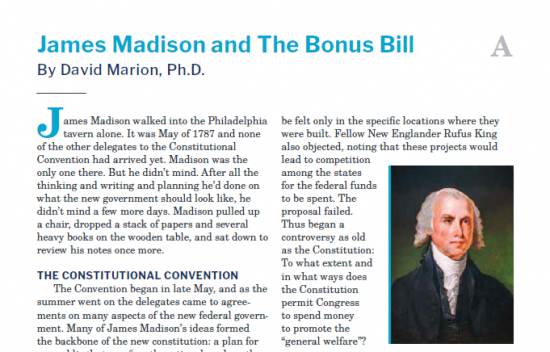
- Handout A: James Madison and the Bonus Bill
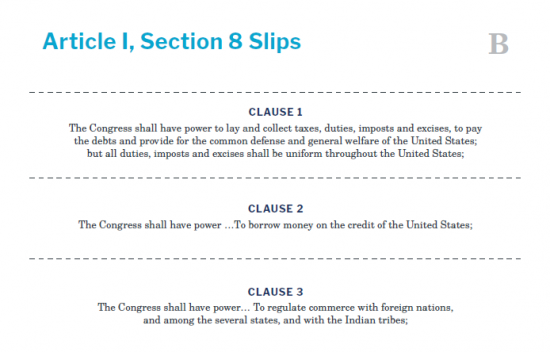
- Handout B: Article I, Section 8 Slips
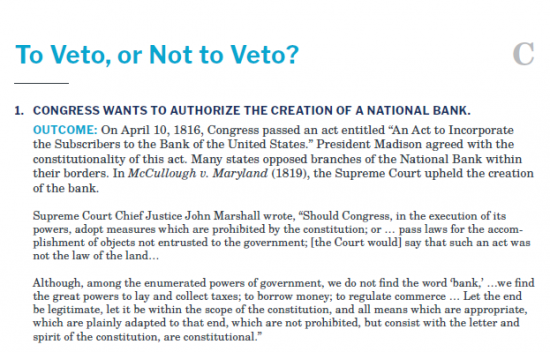
- Handout C: To Veto, or Not to Veto?
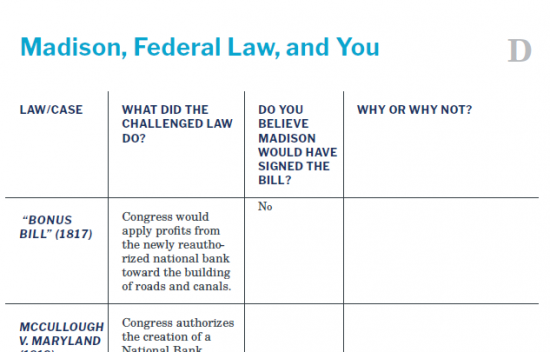
- Handout D: Madison, Federal Law, and You
Lesson Components
Lesson plan
More Information
To create a context for this lesson, have students complete Constitutional Connection: The President and Federal Power.
Standards
Related materials

In this lesson, students will analyze James Madison’s contributions through diligence to the establishment of the United States Constitution and early republic, exploring events that earned him the title, “Father of the Constitution.”

No other Founder had as much influence in crafting, ratifying, and interpreting the United States Constitution and the Bill of Rights as he did. A skilled political tactician, Madison proved instrumental in determining the form of the early American republic.

This month’s Presidents and the Constitution focuses on James Madison, “Father of the Constitution” and fourth President of the United States. Madison, who had urged that Congress be given power to build roads and canals at the Constitutional Convention, vetoed a bill providing for the building of roads and canals.