Lesson
Korematsu v. United States and Japanese Internment DBQ

Objectives:
- Students will understand the major events related to the internment of Japanese Americans during World War II.
- Students will examine and apply constitutional principles at issue in Korematsu v. U.S.to evaluate the Supreme Court’s ruling in that case.
- Students will write a thesis statement that responds to a document-based question prompt.
Materials
Lesson Components
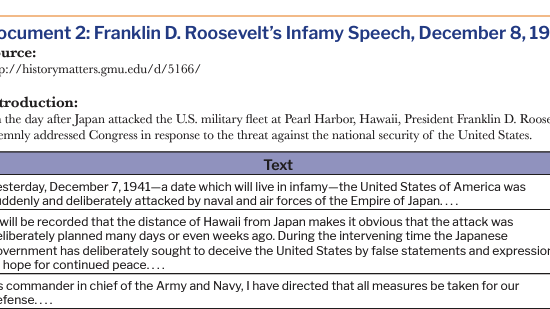
How did wartime experiences lead to challenges to the civil liberties Japanese Americans? Use these eight primary sources which include excerpts of the U.S. Constitution, Executive Order 9066, and opinions for the Korematsu v. United States Supreme Court Case to help students explore this question.
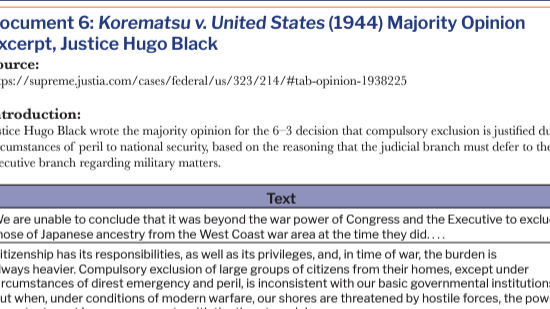
How did wartime experiences lead to challenges to the civil liberties Japanese Americans? This set contains the majority and dissenting opinions from the Korematsu v. United States Supreme Court Case and a 1983 White House Report to help students explore this question.
Lesson plan
More Information
Students should have prior knowledge of how to approach primary sources and of events on the home front during World War II. Background knowledge should include the context of nativism/racism that has shadowed U.S. history in general and , more specifically, negative attitudes toward Asian immigrants and their descendants . These instructions will facilitate a moot court in which students consider the same questions the Supreme Court did.
Standards
Advanced Placement
- Topic 7.12 · World War II: Mobilization
- Theme · Social Structures
- Learning Objective · Unit 7L
- Historical Development · 7.3.III.C.i
- Reasoning Skill · Developments and Processes
- Reasoning Skill · Sourcing and Situation
- Reasoning Skill · Source Claims and Evidence
- Reasoning Skill · Contextualization
- Reasoning Skill · Making Connections
- Reasoning Skill · Argumentation
- Reasoning Process · Causation
Check whether this resource aligns with your state’s standards →
Related materials


In this Homework Help narrative, learn the story of Fred Korematsu and his lifelong struggle for justice for himself and the thousands of Japanese-Americans wrongfully interned by the U.S. government during World War II.