Lesson
The Rise of American Power in the World

Founding Principles
Due Process, Equality, Federalism, Freedom of Speech, Limited Government, Property Rights, Rule of Law, Separation of Powers
Objectives
- Students will trace the changes in American foreign policy in the Gilded Age and World War I era.
- Students will identify the key causes and consequences of the United States’ shift toward a more active role in the world in the 1890s.
- Students will analyze the debates in the U.S. surrounding the Spanish-American War, the annexation of the Philippines, entry into World War I, and entry into the League of Nations.
Materials
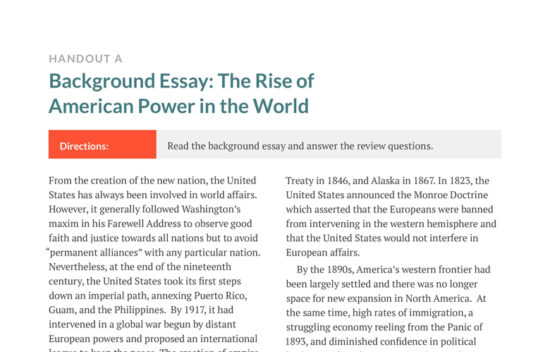
- Handout A: Background Essay: The Rise of American Power in the World
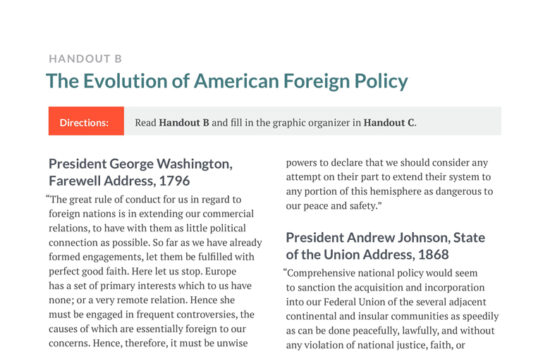
- Handout B: The Evolution of American Foreign Policy
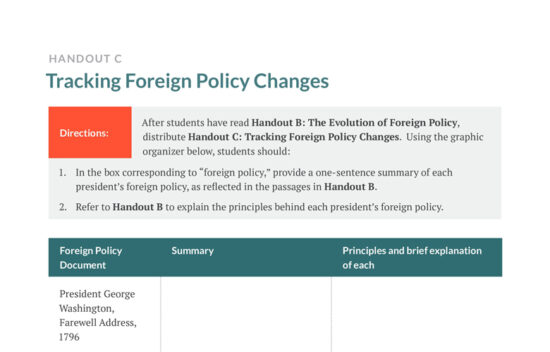
- Handout C: Tracking Changes in Foreign Policy
- Handout D: The Debate on the Annexation of the Philippines
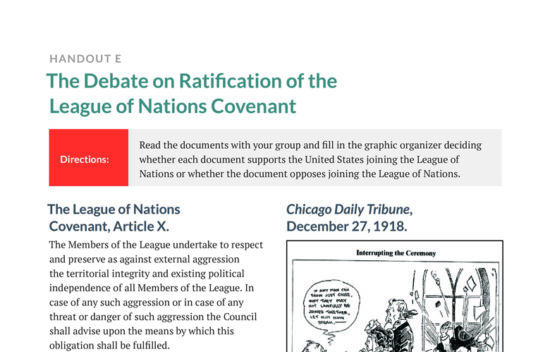
- Handout E: The Debate on the Ratification of the League of Nations Covenant
Lesson Components

Lesson plan
Activity I » 30 minutes
Distribute Handout A: Background Essay: The Rise of American Power in the World to your students and have them read the essay and answer the review questions. This activity may alternatively be completed as homework the night before the lesson.Activity II » 60 Minutes
- Distribute Handout B: The Evolution of American Foreign Policy to your students and have them read the document, taking note of the changes in foreign policy over time.
- Distribute copies of Handout C: Tracking Changes in Foreign Policy. Follow the directions included in Handout C.
Activity III » 60 Minutes
- Distribute Handout D: The Debate on the Annexation of the Philippines to your students and have them read the document, taking note of the primary arguments which were levied by individuals on either side of the debate.
- Prepare for a live debate in the classroom.
- Divide students into two factions: pro-annexation and anti-annexation. Give each side fifteen minutes to prepare a five-minute speech in favor of their position, drawing from their readings. Each group should select one person to deliver this speech. The pro-annexation speaker should speak first, followed by the anti-annexation speaker. Next, give each speaker two minutes to cross-examine one another.
- Give both teams five minutes to prepare a new, five-minute speech in which they attack the opposing side’s position and re-assert without repeating points that were made previously. Different individuals should deliver this speech. After their speeches are complete, they should cross-examine one another for two minutes.
- With one minute for preparation time, each team will send a final speaker to deliver a final, one-minute summary of their argument in favor of their position.
- After the debate is finished, conduct an anonymous vote to see which side was more persuasive.
Activity IV » 30 Minutes
- Break the students up into small groups. Distribute Handout E: The Debate on the Ratification of the League of Nations Covenant to your students and have them read the documents. Ask the groups to read and analyze the documents and fill in the graphic organizer for each document to reflect whether it supports or opposes the United States joining the League of Nations.
- Discuss the answers the students give and have them justify their answers with specific evidence from the primary source quotes.
Key Terms
- Monroe Doctrine
- Annexation
- Alaska Purchase
- Yellow journalism
- Humanitarianism
Standards
Advanced Placement
- National
Check whether this resource aligns with your state’s standards →
Related materials

By the end of this section, you will explain the effects of the Spanish-American War.

In this lesson, students will learn about Theodore Roosevelt, who exercised courage to overcome illness and to lead troops in Cuba. They will also consider how to cultivate and apply courage in their own lives.

By the end of this section, you will explain the causes and consequences of U.S. involvement in World War I.


In this session, we focus on developments in American foreign policy at the turn of the twentieth century, focusing on Imperialism, World War I, and the Versailles Treaty, as well as on cultural and economic developments of the 1920s.