Lesson
Rutherford B. Hayes and the Disputed Election of 1876
Guiding question
Evaluate Congress’ decision to devise an “extra-constitutional” solution to the electoral vote controversy of 1876.

Objectives:
Students will:
- Trace the events that led to the election of Rutherford B. Hayes.
- Analyze the provisions of the US Constitution that describe the presidential election process.
- Evaluate Congress’ appointment of a special commission in absence of any constitutional provision for disputed electoral vote counts.
- Predict solutions should a similar situation arise in the future.
Materials
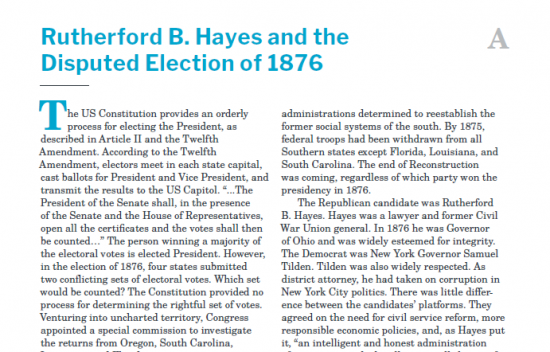
- Handout A: Rutherford B. Hayes and the Disputed Election of 1876
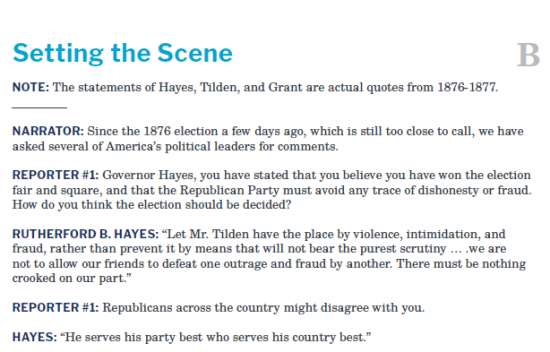
- Handout B: Setting the Scene
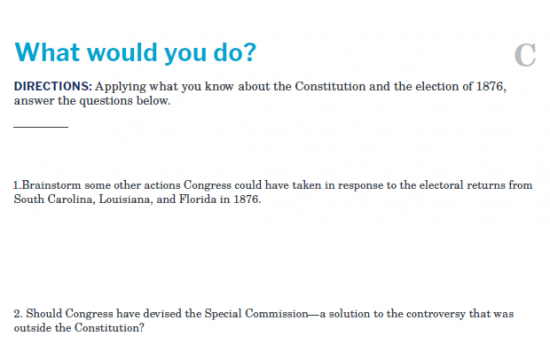
- Handout C: What Would You Do?
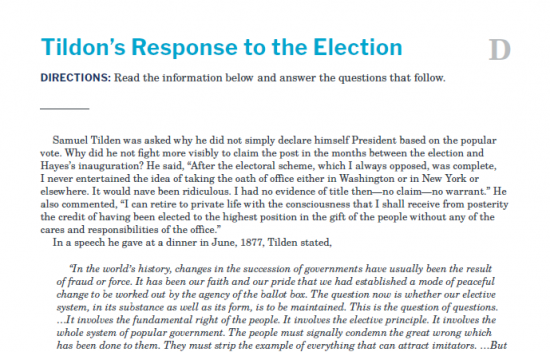
- Handout D: Tilden’s Response to the Election
Lesson Components
Lesson plan
More Information
To create a context for this lesson, students complete Constitutional Connection: Electing The President.
Standards
Related materials

Why was the presidential election of 2000 so controversial, and what constitutional questions were raised during the vote count? This Homework Help video explores these questions to help students understand the fundamental issues at hand in the case of Bush v. Gore.

The controversy of the election of 2000, unlike the elections of 1800 and 1824, was not at the national level but in a single state. After the United States Supreme Court halted a statewide manual recount ordered by the Florida Supreme Court, Florida’s electoral votes—and the Presidency—went to George W. Bush. In this lesson, students will explore the statutes, arguments, and court decisions that led to the Supreme Court’s ruling. Finally, they will evaluate the Court’s decision.