Lesson
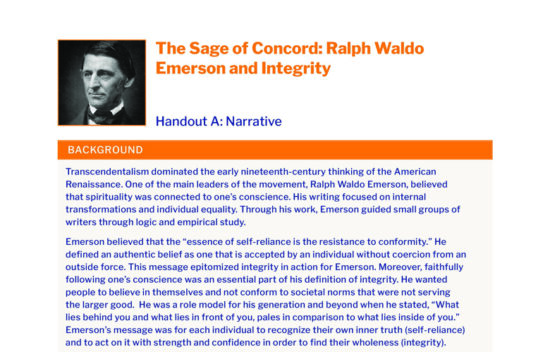
The Sage of Concord: Ralph Waldo Emerson and Integrity

How did Ralph Waldo Emerson act with integrity?
Founding Principles
Guiding questions
Walk-In-The-Shoes Questions
As you read, imagine you are the protagonist.
- What challenges are you facing?
- What fears or concerns might you have?
- What may prevent you from acting in the way you ought?
Observation Questions
- Who was Ralph Waldo Emerson? Why was he significant?
- What was Ralph Waldo Emerson’s purpose in leaving the ministry?
- What actions did Ralph Waldo Emerson take to promote self-reliance and integrity?
- How did Ralph Waldo Emerson’s integrity help to advance freedom?
Discussion Questions
Discuss the following questions with your students.
- What is the historical context of the narrative?
- What historical circumstances presented a challenge to the protagonist?
- How and why did the individual exhibit a moral and/or civic virtue in facing and overcoming the challenge?
- How did the exercise of the virtue benefit civil society?
- How might exercise of the virtue benefit the protagonist?
- What might the exercise of the virtue cost the protagonist?
- Would you react the same under similar circumstances? Why or why not?
- How can you act similarly in your own life? What obstacles must you overcome in order to do so?
Learning objectives
- Students will analyze Ralph Waldo Emerson’s decision to leave the ministry in order to maintain his integrity.
- Students will apply their knowledge of integrity to their own lives.
Lesson Components
Standards
Advanced Placement
- Integrity
Check whether this resource aligns with your state’s standards →