Lesson
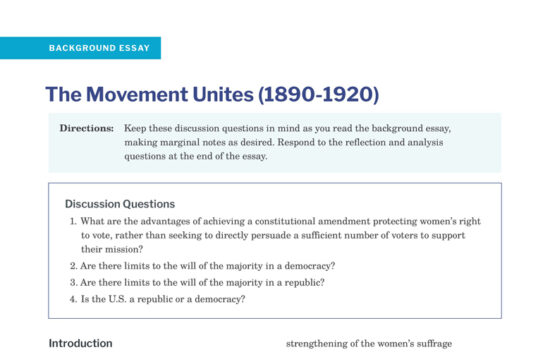
The Movement Unites (1890-1920)

Founding Principles
Civic Virtue, Consent of the Governed, Equal Protection, Equality, Federalism, Liberty, Representative / Republican Government
Materials
- Background Essay: The Movement Unites (1890-1920)
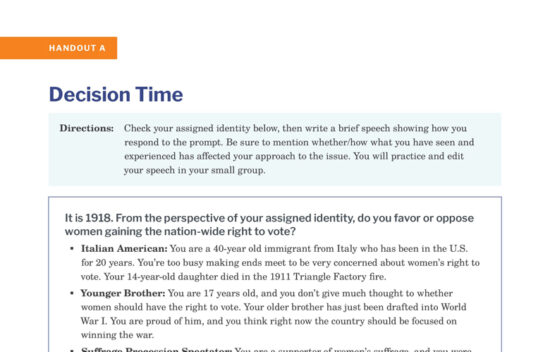
- Handout A: Decision Time
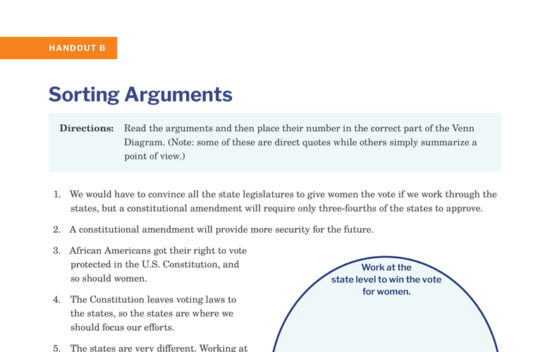
- Handout B: Sorting Arguments
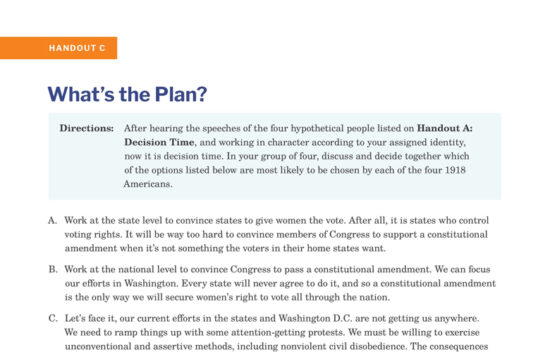
- Handout C: What’s the Plan?
- Handout D: Harry T. Burn Newspaper Interview
- Handout E: Suffrage by State
- Handout F: Carrie Chapman Catt Speech Excerpt
- Appendix A: Amending the Constitution
- Appendix B: Timeline and Quotes
- Appendix C: Timeline Cards
- Appendix G: A Pathway for Change
- Answer Key
Lesson Components


Lesson plan
Key Terms
- Progressive Movement
- Labor unions
- Triangle Shirtwaist Factory
- Temperance
- Municipal Housekeeping
More Information
FOR FURTHER READING
- Abbot, Lyman “Why Women Do Not Wish the Suffrage,” The Atlantic, September (1903)
- Addams, Jane “The Modern City and the Municipal Franchise for Women,” NAWSA Convention (1900)
- Addams, Jane “If Men Were Seeking the Franchise” (1913)
- Addams, Jane “Women’s Memories—Challenging the War” (1916)
- Flexner, Eleanor and Ellen Fitzpatrick. Century of Struggle: The Woman’s Rights Movement in the United States (New York: Belknap, 1996), Chapters 16, 19-23.
- Howe, Marie Jenney “An Anti-Suffrage Monologue” (1913)
- Kelley, Florence “Working Women’s Need of the Ballot,” NAWSA Convention, (1898)
- Stanton, Elizabeth Cady “Solitude of Self” (1882)
- Stetson, Charlotte Perkins [Later Gilman], “The Ballot is an Improver of Motherhood”, NAWSA Convention (1896)
Standards
Advanced Placement
- National
Check whether this resource aligns with your state’s standards →
Related materials

In part two of this two-part Homework Help narrative, learn about the challenges that the women’s suffrage movement overcame in the late nineteenth and early twentieth centuries. What contributions did monumental suffragists like Alice Paul, Lucy Stone, and Carrie Chapman Catt make on the journey to winning the vote for women?

How did Alice Paul fight for equality of the sexes?

In this lesson, students will learn about the self-sacrifice of Alice Paul and ways in which they can sacrifice their own comfort for what they believe.

Use this Lesson with Alice Paul and the Struggle for Women's Suffrage Narrative, the Elihu Root vs. William Jennings Bryan on Women's Suffrage, 1894-1914 Primary Source, and the Carrie Chapman Catt, Open Address to the U.S. Congress, 1917 Primary Source to further explore the journey of the women's suffrage movement.