Lesson
The Path to Independence

Founding Principles
Objectives:
This lesson will walk students through the various declarations made by the colonists, leading up to the Declaration of Independence. Students will:
- Evaluate calls for resistance against Britain and how they appealed to the rights of British subjects, the rights of the individual, local traditions of self-rule, and the ideas of the Enlightenment.
- Explore how ideas about democracy, freedom, and individualism are expressed in some of documents that chronicle the steps toward independence.
- Analyze the colonists’ changing goals over time with respect to their relationship to Great Britain.
Materials
- Handout A: Key Excerpts from the Declaration of Independence, July 4, 1776
- Handout B: The Path to Independence Graphic Organizer
- Handout C: Resolutions of the Continental Congress: Declaration of Rights and Grievances, October 19, 1765
- Handout D: Declaration and Resolves of the First Continental Congress, October 14, 1774
- Handout E: Journals of the Continental Congress: Petition to the King, July 8, 1775; Olive Branch Petition (Excerpts), July 5, 1775
- Handout F: The Declaration of the Causes and Necessity of Taking Up Arms, July 6, 1775 (excerpts)
- Handout G: Proclamation of Rebellion, August 23, 1775
- Handout H: The Path to Independence Timeline
- Handout I: Discussion Questions and Exit Ticket
Chapter Resources:
- Stamp Act Resistance Narrative
- The Boston Massacre Narrative
- The Boston Tea Party Narrative
- John Dickinson, Letters from a Farmer in Pennsylvania, 1767–1768 Primary Source
- Thomas Paine, Common Sense, 1776 Primary Source
Additional Resources:
- Declaration of Rights and Grievances: http://www.loc.gov/teachers/classroommaterials/presentationsandactivities/presentations/timeline/amrev/rebelln/rights.html
- The Olive Branch Petition: http://avalon.law.yale.edu/18th_century/contcong_07-08-75.asp
- The Declaration of the Causes and Necessity of Taking Up Arms: http://avalon.law.yale.edu/18th_century/arms.asp
- The Proclamation of Rebellion: http://www.britannia.com/history/docs/procreb.html
- Declaration and Resolves of the First Continental Congress: http://avalon.law.yale.edu/18th_century/resolves.asp
Lesson Components

Excerpts of the Declaration of Independence and comprehension questions that explore the principles of individual rights, democracy, freedom, and self-government.

A graphic organizer that helps student understand the documents that proceeded the Declaration of Independence in the Colonist relationship to the British Parliament.

A sequencing activity to help students understand the order of the response of the Colonists to the British Parliament.
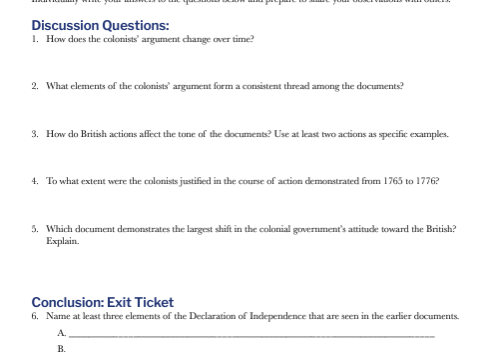
A concluding set of questions that should be used after students work through the Acts of Parliament primary sources and the Colonists response primary sources.

The text of this source with questions that guide students in understanding the effect of Parliaments actions on the Colonists.

An excerpted version of the text of this source with questions that guide students in understanding the effect of Parliaments actions on the Colonists.

Excerpted versions of the texts of these source with questions that guide students in understanding the effect of Parliaments actions on the Colonists.

The text of this source with questions that guide students in understanding the effect of Parliaments actions on the Colonists.
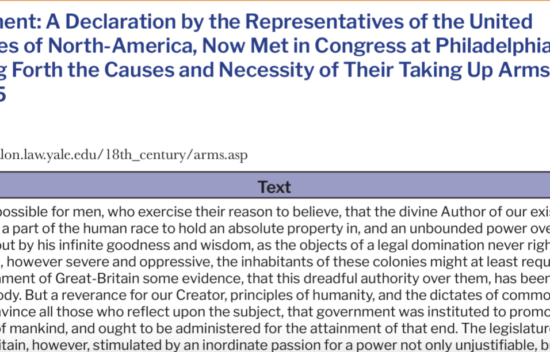
An excerpted version of the text of this source that guides students in their understanding.
Lesson plan
More Information
Groups should be assigned ahead of time to ensure appropriate grouping strategies for your classroom. If desired, roles such as Researcher, Reader, Time Keeper, and Presenter can be assigned, or students can choose roles within groups. Sufficient board space should be reserved to allow students to write on the timeline.
Standards
Advanced Placement
- Topic 3.3 · Taxation Without Representation
- Theme · America in the World
- Learning Objective · Unit 3C
- Historical Development · 3.1.II.A
- Historical Development · 3.1.II.B
- Historical Development · 3.1.II.C
- Reasoning Process · Causation
- Reasoning Process · Continuity and Change
Check whether this resource aligns with your state’s standards →
Related materials


Why did the colonists declare independence from Britain?


America's Founders looked to the lessons of human nature and history to determine how best to structure a government that would promote liberty. They started with the principle of consent of the governed: the only legitimate government is one which the people themselves have authorized. But the Founders also guarded against the tendency of those in power to abuse their authority, and structured a government whose power is limited and divided in complex ways to prevent a concentration of power. They counted on citizens to live out virtues like justice, honesty, respect, humility, and responsibility.

An introductory activity to guide students through discovery of the Declaration of Independence.
Excerpts of the Declaration of Independence and comprehension questions that explore the principles of individual rights, democracy, freedom, and self-government.


How should someone act in the face of a government that violates natural rights instead of protecting them?


Why did Thomas Paine truly think that independence from Great Britain was “common sense”? In this episode of Primary Source Close Reads Explained, Kirk dissects Paine’s “Common Sense” pamphlet published in January 1776. At this point, declaring independence was not a foregone conclusion, and Paine’s pamphlet argued that persistent connection to the nation provided no advantage to the American people. How does Paine’s argument differ from others who wrote in opposition to Great Britain at the time? What reasons does he highlight as imperative for severing ties with the nation? How can words, written and spoken, change history? “Primary Source Close Reading: Explained,” dives even deeper into some of the most pivotal pieces that shaped the America we know today. Join BRI’s Director of Content, Kirk Higgins, as he takes a detailed look at the language contained in the most formative documents, speeches, and court cases throughout the history of the United States. Learn the true meaning and story behind the writing that fashioned the country in a way you can easily digest!

How does the Declaration of Independence support the principles of individual liberty and self-government? In this rapid-fire episode of BRI’s Primary Source Essentials and Declaration of Independence summary, learn the arguments made by the American colonists as they sought to free themselves of British control.

What was the Continental Congress's argument for Independence? Join Kirk Higgins, as he takes a line by line look at the the Declaration of Independence.

Use this primary source text to explore key historical events.

Readings documenting the course of the American Revolution.

A research project to guide students understanding of individuals from the time period.
