Lesson
The American Revolution Grouping Sources and Thesis Deconstructed DBQ Mini-Lesson
Guiding question
How did British and colonial perspectives on taxation, representation, and self-governance compare in the decades leading up to the American Revolution?
Founding Principles
Virtues
Objectives:
- Students will define and understand the purpose of grouping sources in historical writing.
- Students will analyze primary sources to develop a thesis in response to a historical prompt.
- Students will use a graphic organizer to outline their line of reasoning.
Materials
Student Resources
- Document Set (choose 1)
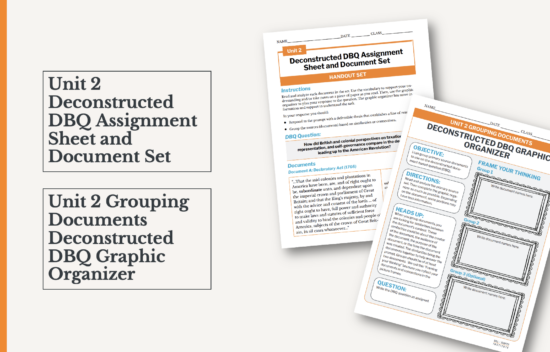
- Unit 2: Grouping Documents Deconstructed DBQ Graphic Organizer
- American Revolution Video
Teacher Resources
Lesson Components
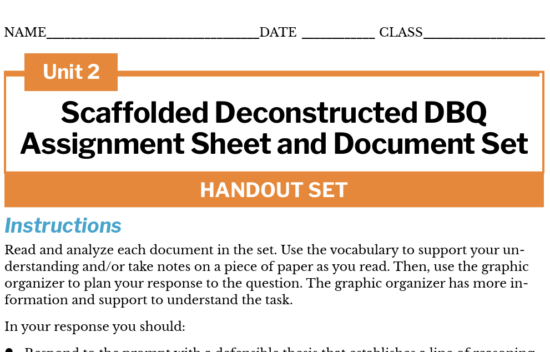
Scaffolded Document Set that addresses the question: how did British and colonial perspectives on taxation, representation, and self-governance compare in the decades leading up to the American Revolution?
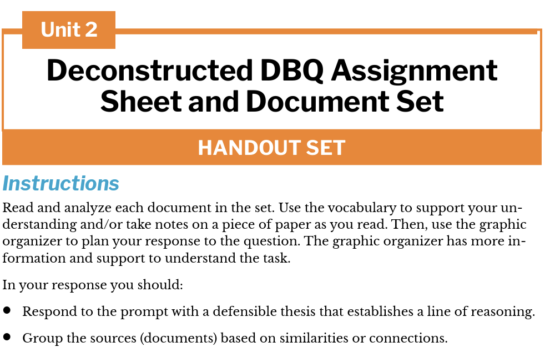
Document Set that addresses the question: how did British and colonial perspectives on taxation, representation, and self-governance compare in the decades leading up to the American Revolution?
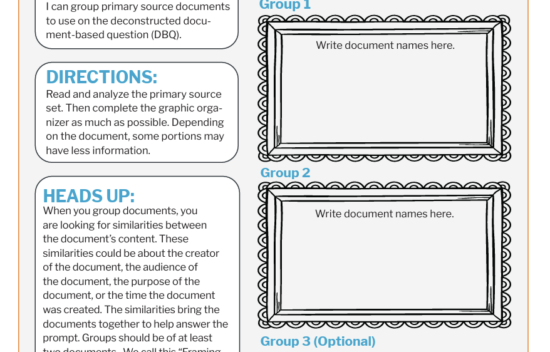
Graphic Organizer to guide students through accompanying documents.
Lesson Components
A pre-made slide deck to accompany this lesson.
Document Set that addresses the question: how did British and colonial perspectives on taxation, representation, and self-governance compare in the decades leading up to the American Revolution?
Scaffolded Document Set that addresses the question: how did British and colonial perspectives on taxation, representation, and self-governance compare in the decades leading up to the American Revolution?
Graphic Organizer to guide students through accompanying documents.
In this middle school history lesson, students explore the growing tension between Britain and the American colonies in the decades leading up to the American Revolution. Using four key documents, the Stamp Act Resolves, the Declaratory Act, The Patriot, and the Declaration of Independence, students investigate how different perspectives on taxation and representation fueled a foundational debate about self-governance. How did British and colonial perspectives on self-governance compare in the decades leading up to the American Revolution? Through guided analysis and color-coded document comparison, students uncover the themes that shaped this revolutionary moment. They’ll practice crafting a thesis supported by evidence, essential skills for completing the unit’s scaffolded Document-Based Question (DBQ) assessment.
Teacher support for implementing the Unit 2: American Revolution Deconstructed DBQ.
Lesson plan
More Information
Facilitation Notes
- This is a mini-lesson. It is intended to be short and directly related to a specific skill. It will take 30-45 minutes of class time. It accompanies the mini-lesson slide deck.
- The mini-lesson is intended to help students develop the skill of grouping sources, which supports forming a strong thesis in historical writing. Students should be familiar with the concept of a thesis statement from the Unit 1 deconstructed DBQ, but they may need support in structuring their reasoning.
Standards
Related materials
In this middle school history lesson, students explore the growing tension between Britain and the American colonies in the decades leading up to the American Revolution. Using four key documents, the Stamp Act Resolves, the Declaratory Act, The Patriot, and the Declaration of Independence, students investigate how different perspectives on taxation and representation fueled a foundational debate about self-governance. How did British and colonial perspectives on self-governance compare in the decades leading up to the American Revolution? Through guided analysis and color-coded document comparison, students uncover the themes that shaped this revolutionary moment. They’ll practice crafting a thesis supported by evidence, essential skills for completing the unit’s scaffolded Document-Based Question (DBQ) assessment.