Lesson
Workers in the Gilded Age and Progressive Era

Founding Principles
Due Process, Equality, Federalism, Freedom of Speech, Limited Government, Property Rights, Rule of Law, Separation of Powers
Objectives
- Students will learn about various incidents of labor strife by participating in role play to reenact the Haymarket Riot, Homestead Strike, and the Pullman Strike.
- Students will evaluate successes and failures of various methods that workers used when seeking to bring about economic and political change.
- Students will analyze constitutional principles and the guarantees of the First Amendment and list recommendations for effectively solving social and economic problems.
- Students will identify examples of the presence or absence of essential virtues for civil society.
Materials
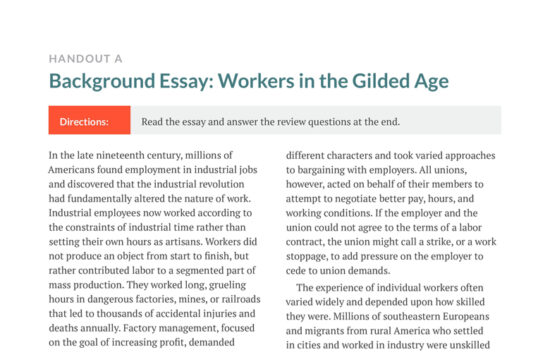
- Handout A: Workers in the Gilded Age
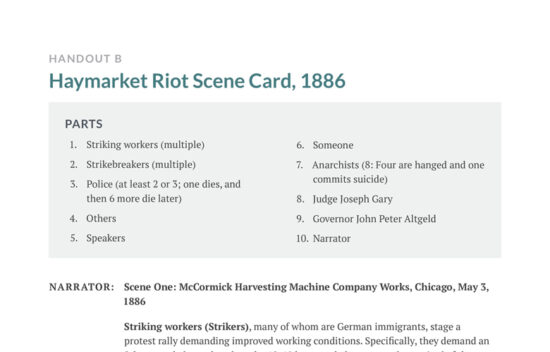
- Handout B: Haymarket Riot Scene Cards, 1886
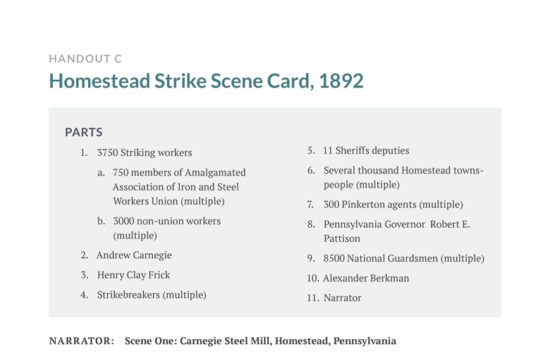
- Handout C: Homestead Strike Scene Cards, 1892
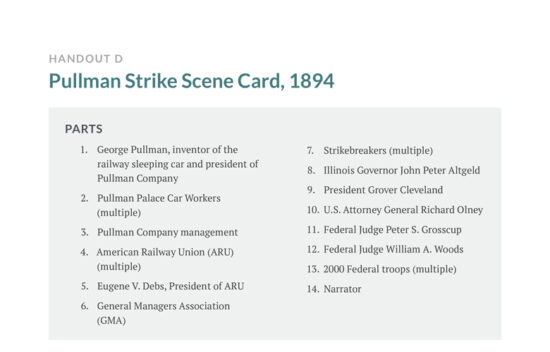
- Handout D: Pullman Strike Scene Cards, 1894
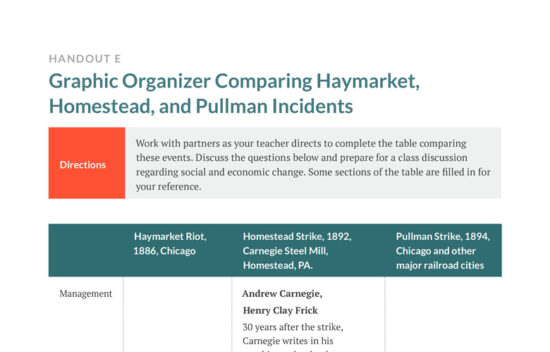
- Handout E: Graphic Organizer Comparing Haymarket, Homestead, and Pullman Incidents
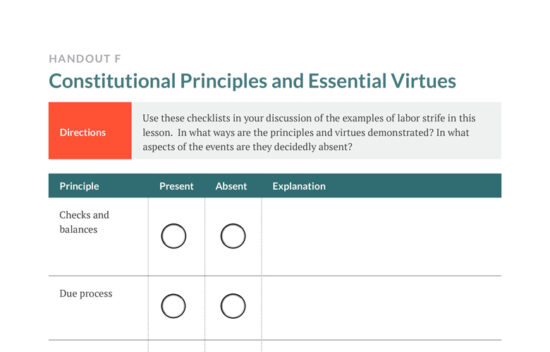
- Handout F: Constitutional Principles and Essential Virtues
Lesson Components
Lesson plan
Key Terms
- Industrial revolution
- Artisans
- Taylorism
- Piecemeal work
- Depression
Standards
Advanced Placement
- National
Check whether this resource aligns with your state’s standards →
Related materials

BRI staff members Rachel and Kirk are joined by Nicole Moretti, World History, World Geography, and AP U.S. History teacher from Lyman, Wyoming, and BRI Teacher Council member, as they discuss the American industrial age and the ensuing economic explosion. They will consider whether the magnates of the Gilded Age were talented individuals whose skills benefitted society as a whole (captains of industry), or selfish individuals who harnessed the worst parts of human nature for their own gain (robber barons). They'll incorporate two contrasting primary sources: "Looking Backward, 2000-1887" by Edward Bellamy and "Wealth" by Andrew Carnegie.

Was the Gilded Age dominated by "robber barons" who stifled competition and oppressed workers, or "captains of industry" who led innovation that benefitted consumers and laborers alike? Professor Domitrovic analyzes the arguments on both side of the debate in this Homework Help video.