Lesson · Elementary (BRI Jr)
Causes of the Civil War for 3-5
Founding Principles
About this lesson
How this lesson flows
Every stage is laid out below, so you can see the whole lesson at a glance. Nothing is hidden.
Guiding questions
- Lesson Plan PDF Essential Question How did regional differences over slavery lead to sectionalism and the C ivil W ar?
- How did slavery deny liberty and natural rights?
- How did slavery lead to sectionalism in the United States?
- How did the presidential election of 1860 reflect sectionalism and tensions that led to war?
Learning Objectives
- I can analyze and discuss primary sources.
- I can annotate a document to identify important vocabulary.
- I can create mock newspaper articles and comics.
- I can read tables and maps to find facts and details about a topic.
Content Objectives
- I can describe the economic, social, and political differences between the North and South prior to the Civil War.
- I can explain how differences led to sectionalism in the mid-1800s.
- I can describe the experiences of enslaved people.
- I can explain how enslavement denied individuals liberty and natural rights.
- I can identify the candidates in the election of 1860, describe their views, and explain why people supported them.
- I can describe the outcome of the election of 1860.
Lesson components
Everything you need, in the version that fits your class.
 Activity3-5 Elementary Vocabulary Word Study Handout
A template to help students define key vocabulary words.
Download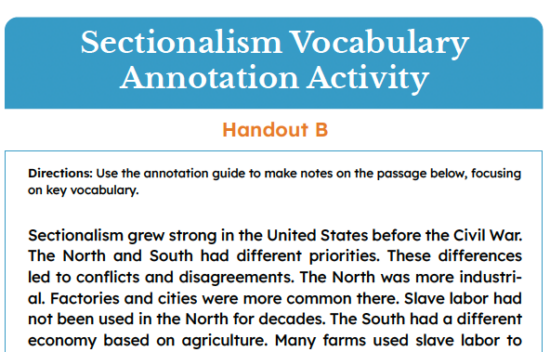 Activity3-5 Elementary Sectionalism Vocabulary Annotation Activity
A reading annotation activity that helps students define the terms related to sectionalism.
Download Activity3-5 Experiences of Enslaved People Primary Sources
A primary source set that focuses on experiences of slavery and discusses sensitive topics surrounding the emotional toll of slavery.
Download Activity3-5 Civil War Talk, Read, Talk, Write: Liberty and Slavery
An activity that guides students through Excerpts from On Liberty and Slavery by George Moses Horton.
Download Activity3-5 Elementary Sectionalism Reading
Readings that provide an overview of the causes of the Civil War.
Download Activity3-5 Elementary Causes of the Civil War Stations Activity
A timeline that explains key decisions and actions that lead to preceded the Election of 1860.
Download Activity3-5 Elementary Causes of the Civil War Stations Handout
A organizer to accompany the lesson reading.
Download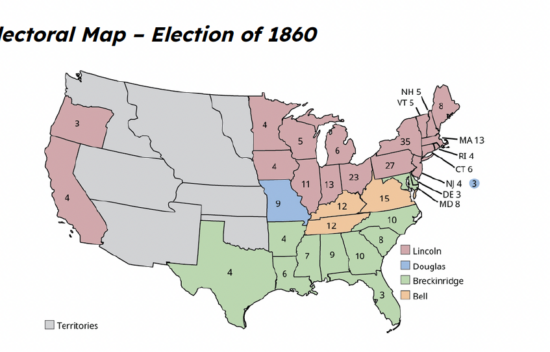 Activity3-5 Elementary Election of 1860 Tables and Map Activity
Sources to help students understand the election of 1860 and comprehension questions.
Download Activity3-5 Elementary Election of 1860 Newspaper Primary Sources
Excerpts from 1860's newspapers that compare and contrast the election coverage in Pennsylvania, Virginia, and Indiana.
Download Activity3-5 Elementary Causes of the Civil War Student Self-Assessment
A self-reflection activity that allows students to internalize their learning.
DownloadMaterials
Teacher Resources
- Vocabulary Cards
- Teacher Slide Deck
- Handout H Answer Key
- Teacher Prep Resources
- Annotation Bookmarks
Student Resources
- Handout A: Vocabulary Word Study
- Handout B: Sectionalism Vocabulary Annotation Activity
- Handout Set C: Experiences of Enslaved People Primary Sources
- Handout D: Talk, Read, Talk, Write: On Liberty and Slavery
- Handout E: Lesson Reading
- Handout Set F: Causes of the Civil War Stations
- Handout G: Student Stations Handout
- Handout H: Election of 1860 Tables and Map Activity
- Handout I: Election of 1860 Newspapers
- Handout J: Newspaper Article Organizer
- Handout K: Newspaper Assignment Sheet
- Handout L: Newspaper Templates
- Handout M: Student Self-Assessment
The lesson, step by step
Open each stage as you teach it, or expand them all to read straight through.
More Information
This lesson is designed around inquiry questions. There is one essential question, and several guiding questions around which the content is based. The lesson takes place in 5 stages:
- Anticipate- Students build background knowledge needed to be successful in the lesson.
- Engage- Students are “hooked” into the lesson.
- Explore- Students grapple with the main content of the unit (usually 2-3 parts).
- Assess- Students demonstrate their knowledge through a performance assessment.
- Reflect- Students reflect on their learning in the lesson.
- The sections below provide a brief overview of the unit’s structure. It offers a snapshot of the organization and flow of the entire unit.
The following detailed sections break down the five stages of the lesson. Each stage is discussed thoroughly with actionable steps to guide you through the teaching process effectively.