Lesson
Congress in the 20th and 21st Centuries

Founding Principles
Consent of the Governed, Representative / Republican Government, Separation of Powers, Checks and Balances
Objectives
- Students will analyze twentieth and twenty-first century reforms of Congress.
- Students will analyze the difference between constitutional reforms and the reforming of congressional rules.
- Students will assess the arguments for and against congressional reforms.
- Students will analyze the effects and significance of these reforms on Congress.
Materials
Student Handouts
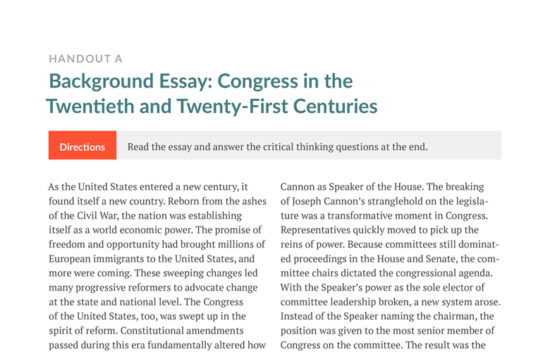
- Handout A: Background Essay – Congress in the 20th and 21st Centuries
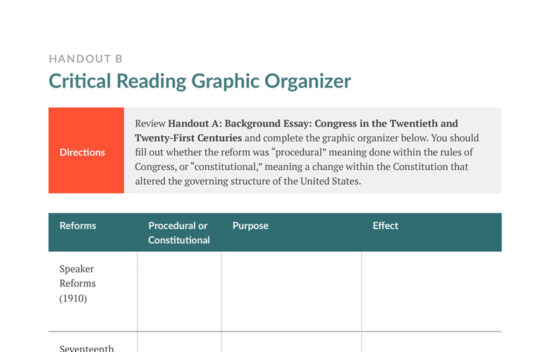
- Handout B: Critical Reading Graphic Organizer
- Handout C: The Indirectly Elected Senate
- Handout D: The Directly Elected Senate
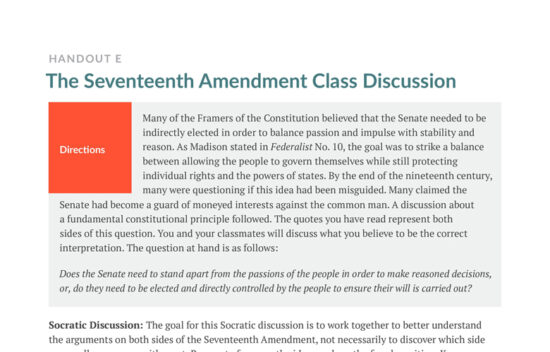
- Handout E: The Seventeenth Amendment Class Discussion
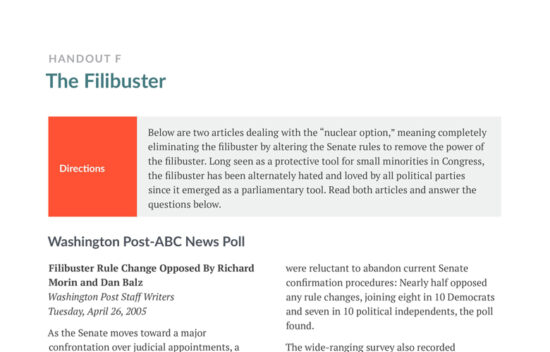
- Handout F: The Filibuster
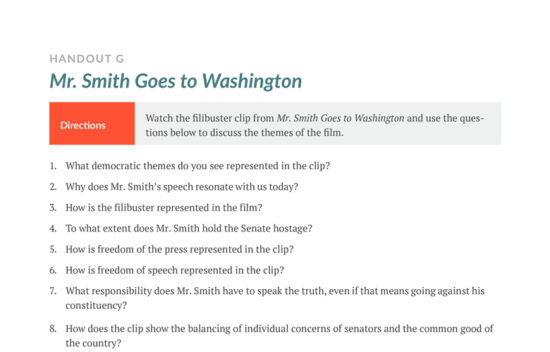
- Handout G: Mr. Smith Goes to Washington
Teacher Resources
Lesson Components


Lesson plan
Key Terms
- Reform
- Progressivism
- Vetting
- Revolt
- Transformative
Standards
Related materials

The twentieth century saw the rise of a widespread but not very clearly defined group of reformers known as the progressives. The basic belief that united them was that the industrialized, urbanized United States of the nineteenth century had outgrown its eighteenth-century Constitution.
In pressing for drastic changes in American society, did the Progressive movement stay true to Founding principles? Mark Thomas and Joseph Postell debate this question.

Part of the Civil War’s legacy was a shift in the role of the national government. The defeat of the South, Reconstruction, and the Supreme Court’s interpretation of the Fourteenth Amendment gave the national government growing power over the states and the people. The Fourteenth Amendment gave the national government power (though exactly how much power was still being debated) to ensure state laws did not violate the rights of the freedmen. Additional amendments during the Progressive Era (the 1890s - 1920s) continued this transfer of power to the national government. In the name of giving power to the people, the national government was given power to tax incomes; states lost their representation in Congress, the manufacture and sale of alcohol was banned, and women achieved the right to vote.

Use this Lesson with the Wilsonian Progressivism Narrative and the Did the Progressive Movement Diverge from Founding Principles and Did It Affect the Purpose of Government? Point-Counterpoint to understand the Progressive Era.

In this episode, we will focus on economic and political developments of the Gilded Age and the Progressive era, with a focus on comparing the relationship between government and big business during these two periods.