Lesson
Consequences of the American Revolution for 3-5
Guiding questions
Lesson Plan PDF
Essential Question:
How did Americans organize their new government after the American Revolution?
Guiding Questions:
- What powers did the Founders assign to the national government under the Articles of Confederation?
- How did this new government align with the goals of the Revolution as outlined in the Declaration of Independence?
- What were the limits and weaknesses of the Articles of Confederation?
Learning Objectives
- I can analyze and interpret political cartoons.
- I can investigate excerpts of a primary source document.
- I can write from the perspective of a historical person.
- I can research an American Founder.
- I can write a monologue.
- I can participate in a class wax museum and recite a monologue to visitors.
Content Objectives
- I can summarize the results of the American Revolution.
- I can identify American Founders and explain their contributions and impact on the early American government.
- I can explain the intent of the Articles of Confederation and why it was adopted.
- I can identify the weaknesses and limitations of the Articles of Confederation.
Materials
Teacher Materials
Student Handouts
- Handout A: Vocabulary Word Study
- Handout B: Political Cartoon Analysis
- Handout C: Lesson Reading
- Handout D: Articles of Confederation Primary Source
- Handout E: Founder Research
- Handout F: Lesson Student Self-assessment
- Handout G: Articles of Confederation Visual Guide
- Handout H: Monologue Peer-review
- Explore #3 Partner Cards
Lesson Components

A template to help students define key vocabulary words.

Two political cartoons that help students understand the term consent of the governed.

Readings that provide an overview of the detail the powers and structure of the Colonial government.

A scaffolded version of the document to help students gain detailed understanding.

A template to prepare students for the Wax Museum presentation.

A step-by-step handout to help students prepare for the verbal portion of their Wax Museum presentation.

A self-reflection activity that allows students to internalize their learning.

A visual representation of the documents main ideas.
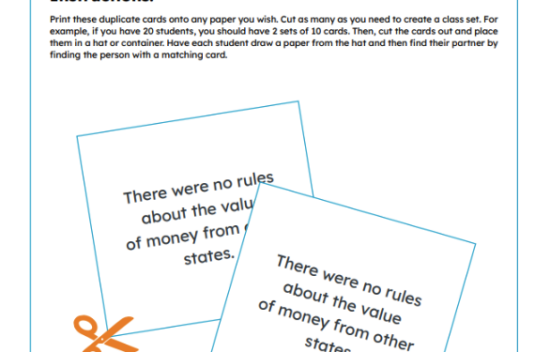
An activity to showcase the differences of opinion present at the first Continental Congress.
Lesson plan
More Information
This lesson is designed around inquiry questions. There is one essential question, and several guiding questions around which the content is based. The lesson takes place in 5 stages:
- Anticipate- Students build background knowledge needed to be successful in the lesson.
- Engage- Students are ‘hooked” into the lesson.
- Explore- Students grapple with the main content of the unit (usually 2-3 parts).
- Assess- Students demonstrate their knowledge through a performance assessment.
- Reflect- Students reflect on their learning in the lesson.
- The sections below provide a brief overview of the unit’s structure. It offers a snapshot of the organization and flow of the entire unit.
The following detailed sections break down the five stages of the lesson. Each stage is discussed thoroughly with actionable steps to guide you through the teaching process effectively.