Lesson
Electing a President
Guiding question
How do the components of the U.S. presidential electoral process function and rely on active political participation by citizens?

Objectives
- Know the steps to electing a president.
- Understand the differences between open and closed primaries and their significance in the election process.
- Explore the role and function of caucuses in the selection of candidates and policy decisions.
- Compare the processes and purposes of party conventions.
- Analyze the function and impact of the Electoral College in electing the President of the United States.
Materials
Resources
- Electing a President Student Handout
- Computers or tablets with internet access for additional research
- Station 1: Open and Closed Primaries
- Think the Vote: Should States Stop Having Closed Primaries?
- Voting mechanism
- Station 2: Caucuses
- Laptop or tablet to view video: Inside a Caucus: Iowa 2008
- Graph paper, poster board, or white board with markers
- Station 3: Party Conventions
- Laptop or table to access two websites
- Station 4: Electoral College
- Laptop or tablet to view video: The Electoral College | Homework Help from the Bill of Rights Institute.
- Station signs (to indicate each activity station)
Lesson Components
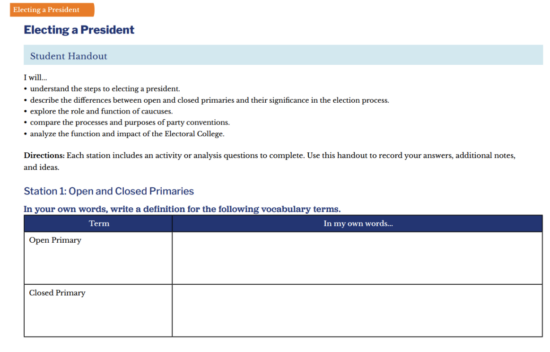
ActivityElecting a President Station Activity
A station based activity to showcase the steps of a US presidential election.

ActivityFederalist 10, Politics and Political Parties
A primary source to explore the dangers of factions and how the Constitution was designed to limit their powers.

ActivityPolitical Parties Research Activity
Explore the modern and historical political parties to understand their foundational positions, key policies, and roles in American politics.

ActivityPolitical Party Changes and Adaptations Graphic Organizer
Guides students through the timeline of political party changes, encouraging them to explain the reasons behind any adaptations or shifts in the party's structure or platform.

EssayThe History of Political Parties in the United States
Explore the history of political parties from the Founding Era to modern day.
Lesson plan
90 minClick a phase to open it
More Information
Overview Information
- This lesson helps students explore the intricacies of the presidential electoral process through engaging station activities. They will investigate open and closed primaries, the role of caucuses, the functions of party conventions compared to general elections, and the significance of the Electoral College. Each station will provide resources and tasks to deepen understanding, culminating in a reflective discussion on the complexities of electing a president.
- By organizing the lesson into stations and providing clear directions for each activity, teachers can effectively guide students through an exploration of the presidential electoral process. This hands-on approach promotes active learning and allows students to delve deeper into specific topics of interest.