Lesson
Elizabeth Eckford and Courage

Founding Principles
Virtues
Guiding questions
Essential Question
- Why is individual courage necessary for the success of the larger community or civil society?
Guiding Questions
- What are the elements required to act courageously?
- What are some possible consequences of doing nothing in the face of injustice?
Learning Objectives
- Students will analyze a primary source image to identify an example of courage through the story of Elizabeth Eckford.
- Students will explain why the aftermath of Brown v. The Board of Education was not a seamless transition to equal education and describe how individuals acted bravely to implement the Court’s ruling.
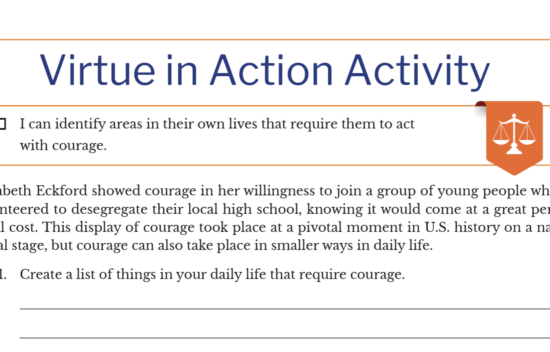
- Students will identify areas in their own lives that require them to act with courage.
Materials
Student Resources
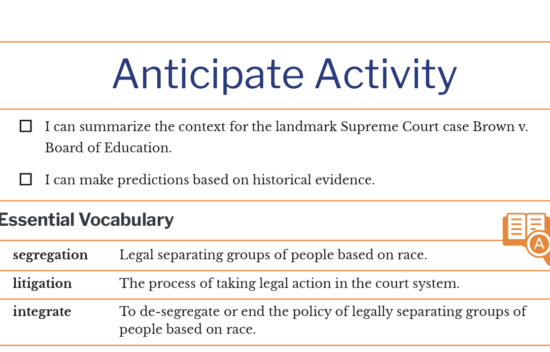
- Anticipate Activity
- Engage: Primary Source Analysis
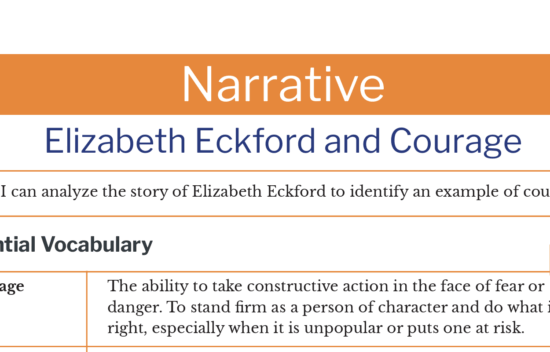
- Elizabeth Eckford and Courage Narrative
- Virtue in Action Activity
Teacher Resources
- Analysis Questions
- Virtue in Action
- Journal Activity
- Sources for Further Reading
- Virtue Across the Curriculum
Lesson Components
Lesson plan
Key Terms
- Courage
- The ability to take constructive action in the face of fear or danger. To stand firm as a person of character and do what is right, especially when it is unpopular or puts one at risk.
- Desegregated
- To end a policy of legally required separation of races.
- Integrate
- To bring separated races together.
- Specter
- The idea of a disturbing event.
More Information
Procedures
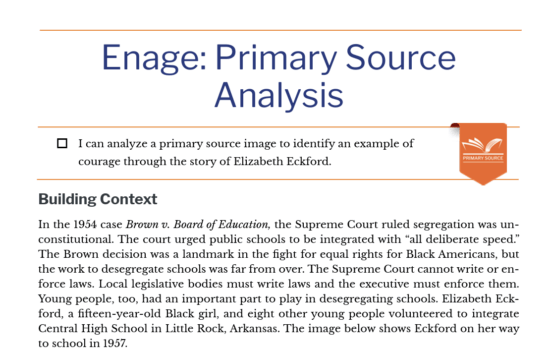
- The following lesson asks students to consider the virtue of courage. Students will engage with the story of Elizabeth Eckford as they consider the essential question: Why is individual courage necessary for the success of the larger community or civil society?
- The main activity in this lesson requires students to read and analyze a narrative that explores Elizabeth Eckford. Students may work individually, in pairs, or small groups as best fits your classroom. The analysis questions provided can be used to help students comprehend and think critically about the content. As the teacher, you can decide which questions best fit your students’ needs and time restraints.
- Additionally, the lesson includes a primary source analysis activity that asks students to explore an image of Elizabeth Eckford and identify her as an example of courage.
- Lastly, the lesson includes sources used in this lesson for further reading and suggestions for cross-curricular connections.
Standards
Related materials

Why is individual courage necessary for the success of the larger community or civil society? Explore the story of Elizabeth Eckford in this video feature of BRI's Heroes and Villains Curriculum to help determine how she exhibited the virtue of courage. Heroes and Villains uses narratives to discuss the concepts of civic virtue in all classrooms. Each virtue narrative includes corresponding discussion guides, journal templates, a toolbox with additional activities, and suggestions for further reading on each topic or virtue.

Brown v Board of Education was a case brought to the Supreme Court in 1954 after Linda Brown, an African American student in Kansas, was denied access to the white-only schools nearby her house. Future Supreme Court Justice Thurgood Marshall was the lawyer for the case, and argued that segregated schools were inherently unequal. Ultimately, the Supreme Court ruled in favor of Linda Brown and declared segregation unconstitutional under the Equal Protection Clause of the 14th Amendment through incorporation under the premise that the bill of rights also applies to the states. This is one of the landmark cases that led to the passage of the Civil Rights Act of 1964.

Explores the idea of equality as seen in two landmark Court cases.