Lesson
Federalism
Guiding question
How has the Constitutional principle of federalism shaped government policies over time?

Provide students with a comprehensive study of federalism. Through the Constitution’s system of federalism, power is divided between national and subnational governments. Federalism allows citizens to make policy decisions at state and local levels. Decentralization draws individuals out of private life and compels civic engagement.
Founding Principles
Guiding Questions
- How has the Constitutional principle of federalism shaped government policies over time?
- How does the legacy of slavery relate to the principle of federalism?
- To what extent and in what ways have the powers and functions of the two levels of government changed in the 20th and 21st centuries?
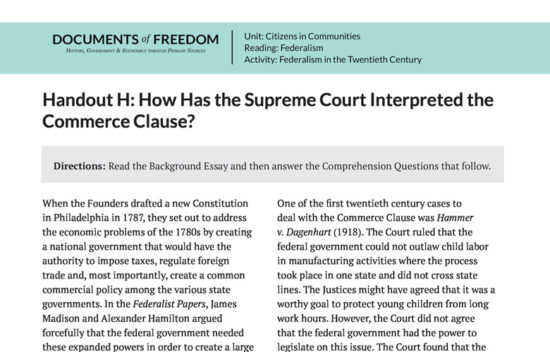
- How has the Supreme Court interpreted the Commerce Clause?
- How did Founders Roger Sherman and James Madison understand federalism?
Objectives
- Students will describe functions of the national government according to Article I of the Constitution.
- Students will explain how the Constitution in Article IV and the Tenth Amendment both prohibits and enables certain state powers.
- Students will define terms: expressed, enumerated, and reserved powers.
- Students will analyze primary sources and the Constitution in order to understand the principle of federalism.
Materials
Student Handouts
- Handout A: Federalism Venn Diagram
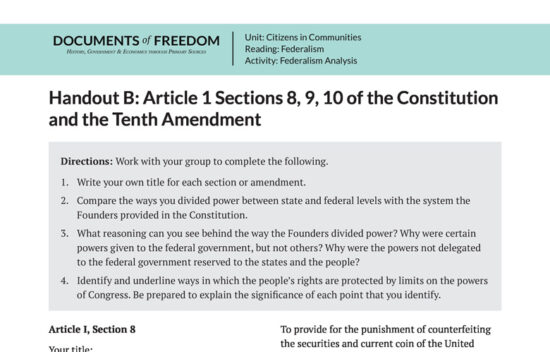
- Handout B: Article I Sections 8, 9, 10 of the Constitution and the Tenth Amendment
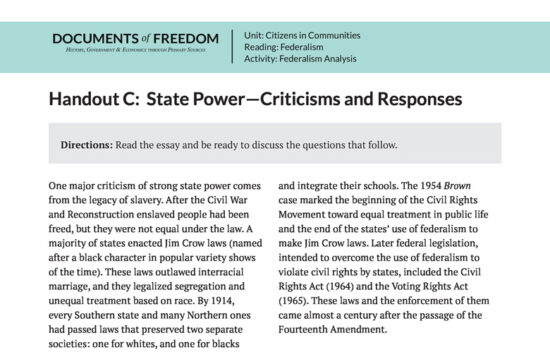
- Handout C: State Power – Criticisms and Responses
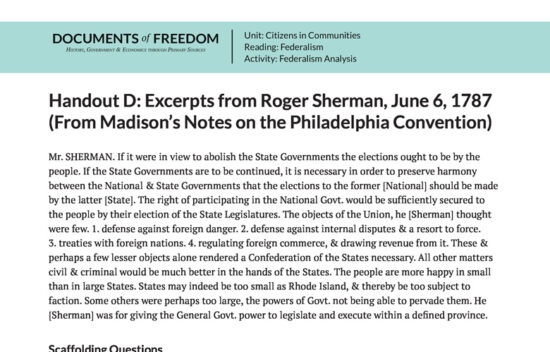
- Handout D: Excerpts from Roger Sherman, June 6, 1787 (From Madison’s Notes on the Philadelphia Convention)
- Handout E: Excerpts from Federalist No. 39, James Madison (1788)
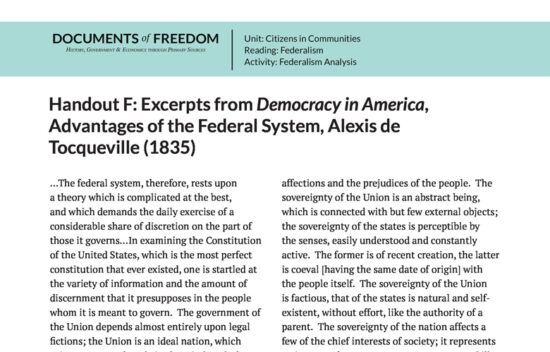
- Handout F: Excerpts from Democracy in America, Advantages of the Federal System, Alexis de Tocqueville (1835)
- Handout G: An Overview of Federalism at the Founding and Early Republic
- Handout H: How Has the Supreme Court Interpreted the Commerce Clause?
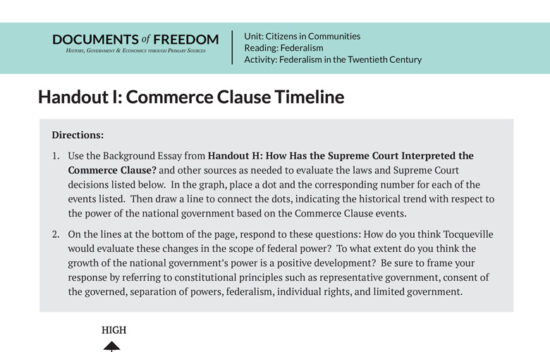
- Handout I: Commerce Clause Timeline
Optional (Supplemental) Videos:
- Federalism | BRI’s Homework Help Series
- Bill of Rights For Real Life: Federalism
- Federalism and the Clarification of Slavery | Dr. Nicholas Cole | BRI’s Constitutional Conversations
- U.S. v. Lopez | BRI’s Homework Help Series
- What is Self-Governance and Why is it Important? | Dr. David Bobb | Constitutional Conversations
Lesson Components



Lesson plan
110 minClick a phase to open it
Key Terms
- Alexis de Tocqueville
- Article I
- Articles of Confederation
- Commerce Clause
- Constitution
Standards
Related materials
EssayEssay: Federalism
Through the Constitution’s system of federalism power was divided between national and subnational governments allowing citizens to decide local questions for themselves. This decentralization he contended draws individuals out of private life and compels them to civic engagement.