Lesson
Huey Long and Immoderation (Extremism)

How should leaders behave and make decisions in a democratic society? Explore these questions through narratives and activities that focus on Huey Long.
Guiding questions
Essential Question
- Why is moderation important in a civil society? In leadership? In the general public?
Guiding Questions
- What is immoderation? And why is Huey Long’s story an example of it?
- How should leaders behave and make decisions in a democratic society?
- When does ambition or trying to reach a goal become an act of immoderation?
Learning Objectives
- Students will describe the importance of moderation in a civil society.
- Students will identify personal behaviors or habits that demonstrate the civic virtue of moderation or the vice of immoderation.
- Students will analyze Huey Long’s story to examine examples of how immoderation or extremism can sabotage ambition.
Materials
Student Resources
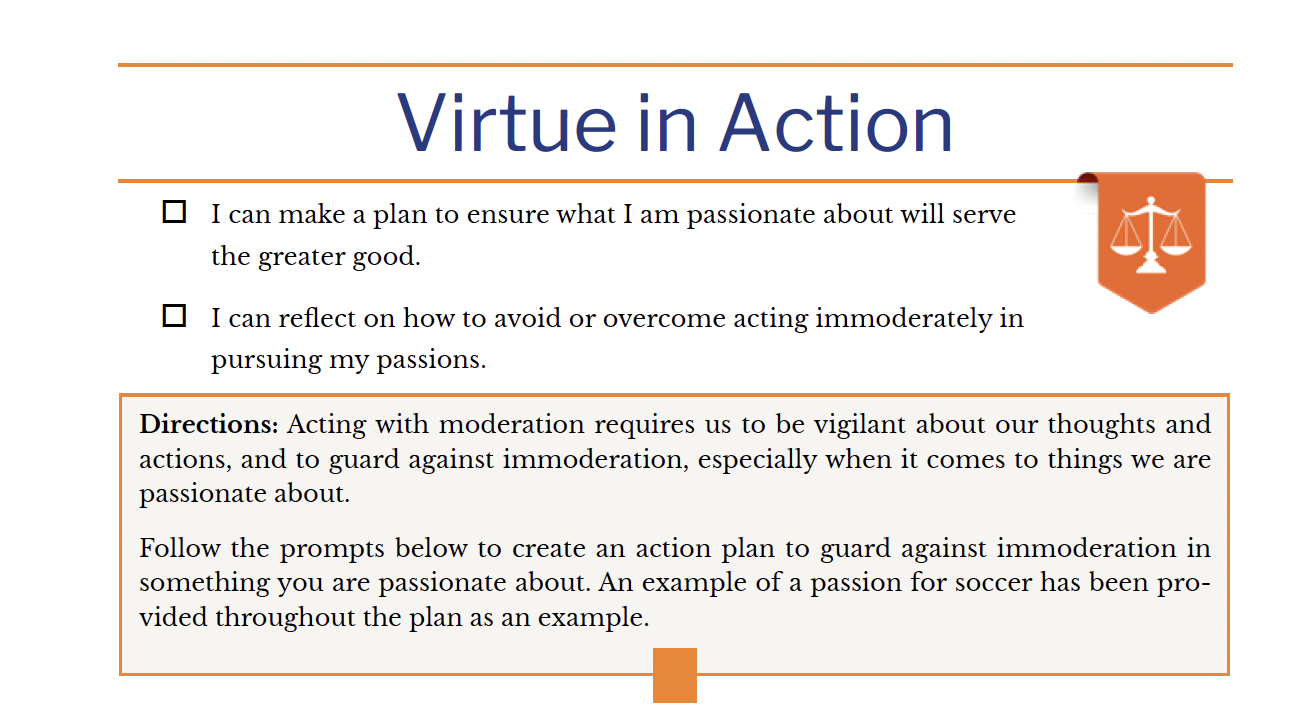
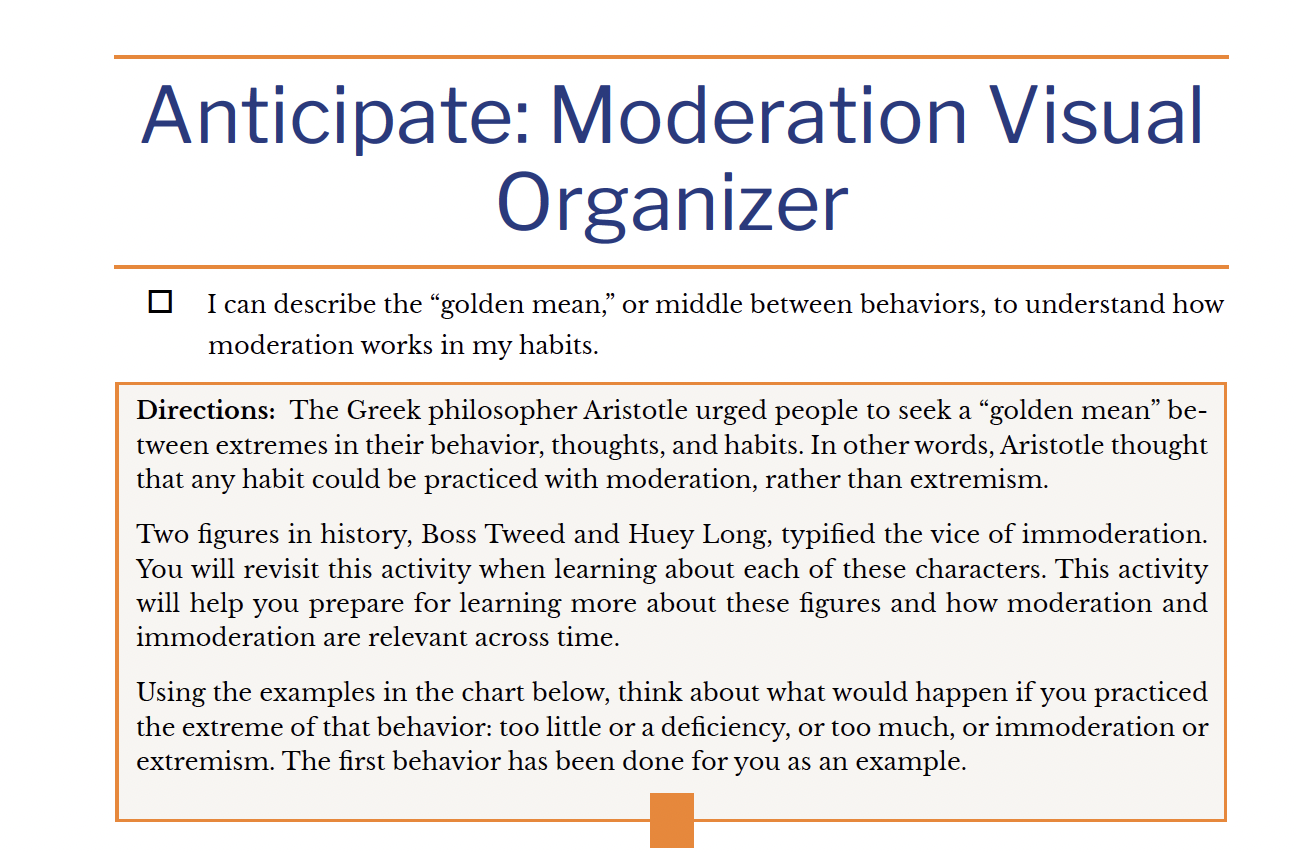
- Anticipate Moderation/Immoderation Organizer
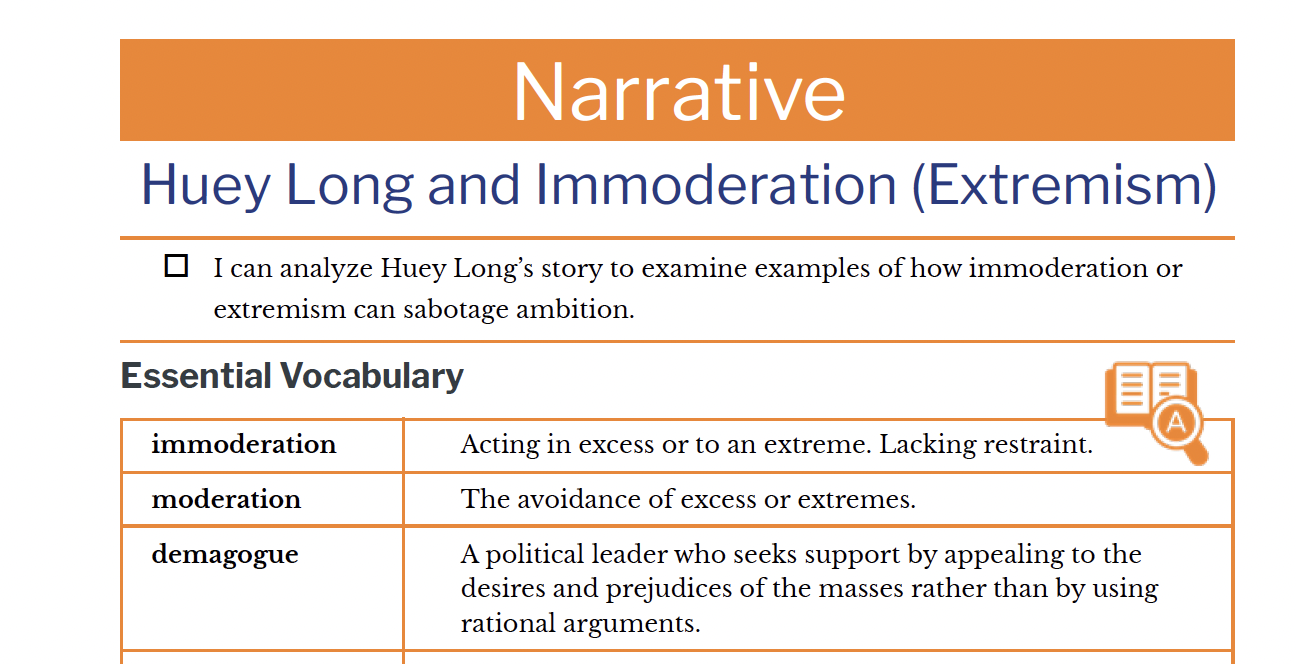
- Huey Long and Immoderation (extremism) Narrative
- Virtue in Action Handout
Teacher Resources
- Analysis Questions
- Virtue in Action
- Journal Activity
- Sources for Further Reading
- Virtue Across the Curriculum
Lesson Components
Lesson plan
90 minClick a phase to open it
Key Terms
- Immoderation (extremism)
- Acting in excess or to an extreme. Lacking restraint.
- Moderation
- the avoidance of excess of extremes.
- Demagogue
- A political leader who seeks support by appealing to the desires and prejudices of ordinary people rather than by using rational arguments.
- Parish
- The state of Louisiana is divided into 64 parishes, which are analogous to counties in other states. There are various forms of government being used within the parishes. Explore the links below to learn more about each parish.
- Patronage
- In politics and government, a spoils system (also known as a patronage system) is a practice in which a political party, after winning an election, gives government jobs to its supporters, friends (cronyism), and relatives (nepotism) as a reward for working toward victory.
More Information
Procedures
- The following lesson asks students to consider the vice of immoderation.
- Students will engage with the story of Huey Long as a warning against immoderation as they consider the questions: Why is moderation important in a civil society? In leadership? In the general public?
- During the 1920s and Great Depression, Huey Long found a receptive audience for his populist attacks on the wealthy and corruption, as millions felt left out because of the rapid changes brought about by modernization and the development of a mass society. They overlooked his corruption and immoderate politics that destroyed the rule of law and a healthy democracy because he promised them a better future.
- The main activity in this lesson requires students to read and analyze a narrative that explores how Huey Long acted immoderately. Students may work individually, in pairs, or in small groups as best fits your classroom. The analysis questions provided can be used to help students comprehend and think critically about the content. As the teacher, you can decide which questions best fit your students’ needs and time restraints.
- Students will reflect and make plans to ensure what they avoid or act immoderately and that their passions will serve the greater good.
- Lastly, the lesson includes sources used in this lesson for further reading and suggestions for cross-curricular connections.
Standards
Related materials

VideoHuey Long and Immoderation: Heroes & Villains
Why is moderation important in a civil society, leadership, and in the general public? Explore the story of Huey Long in this video feature of BRI's Heroes and Villains Curriculum to help determine how he exhibited the vice of immoderation.

ActivityHuey Long and the American Liberty League, 1934
Use this primary source text to explore key historical events.

ActivityRun of Show Government and Politics Card Game
A role play and engine building game that juxtaposes the skill of campaigning with the changing timeline of a political season.