Lesson
John Brown and Self-Deception

What is the vice of self-deception? Examine whether John Brown deceived himself with self-righteousness by thinking that he could end slavery in the antebellum United States by freeing and arming slaves to launch a racial war in the South.
Founding Principles
Virtues
Guiding questions
Essential Question
- Why is self-deception destructive to a healthy civil society?
Guiding Questions
- When can an individual or a group justifiably decide to break the law?
- How can people become so deceived by ideas that they will commit horrific acts against others?
- How can one prevent themselves from being deceived by harmful ideas?
Learning Objectives
- Students will analyze the story of John Brown to identify examples of self-deception.
- Students will compare primary sources from John Brown and other historic examples to explain the dangers of self-deception in a civil society.
- Students will apply an understanding of the consequences of self-deception to their own behaviors.
Materials
Student Resources
- John Brown and Self-Deception Narrative
- Primary Source Activity Handout and Graphic Organizer
- Scaffolded Primary Source Activity Handout and Graphic Organizer
Teacher Resources
- Analysis Questions
- Virtue in Action
- Journal Activity
- Sources for Further Reading
- Virtue Across the Curriculum
Lesson Components
Lesson plan
60 minClick a phase to open it
Key Terms
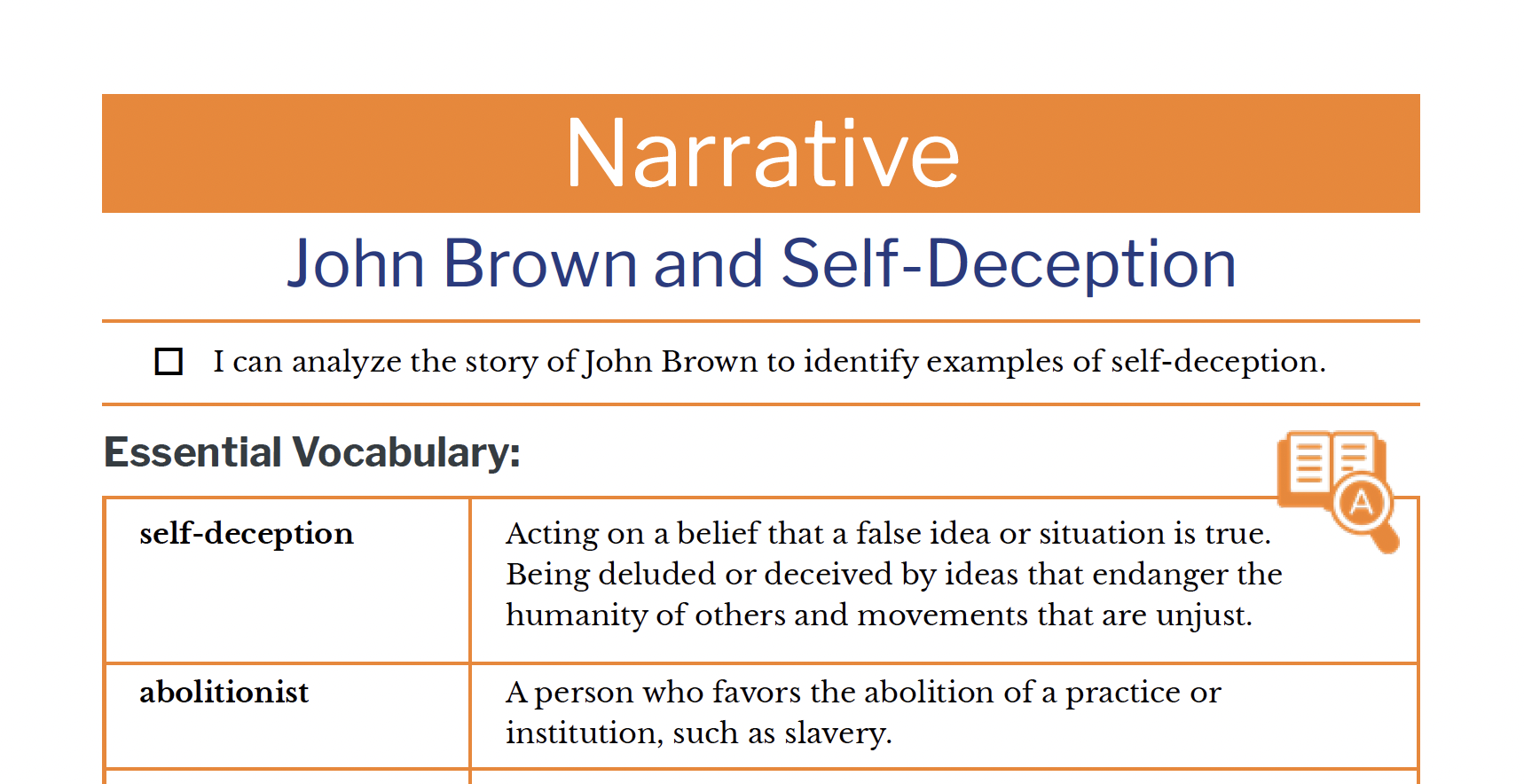
- Self-deception
- Acting on a belief that a false idea or situation is true. Being deluded or deceived by ideas that endanger the humanity of others and movements that are unjust.
- Abolitionist
- A person who favors the abolition of a practice or institution, such as slavery.
- Equivocate
- To use unclear language, especially to deceive or mislead someone.
- Consecrate
- To make or declare something sacred.
- Deceive
- To make someone believe something that is not true.
More Information
Procedures
- The following lesson asks students to consider the vice of self-deception and how it can cause an individual to fail to act with integrity. Students will engage with the story of John Brown, as they consider the essential question: Why is self-deception destructive to a healthy civil society?
- The main activity in this lesson requires students to read and analyze a narrative that explores John Brown’s decisions that led him to self-deception. Students may work individually, in pairs, or small groups as best fits your classroom. The analysis questions provided can be used to help students comprehend and think critically about the content. As the teacher, you can decide which questions best fit your students’ needs and time restraints.
- The lesson includes a variety of activities and suggestions for your classroom. Time estimates are included in the activities, so that you can decide what’s most appropriate for your teaching.
- Additionally, the lesson includes primary source analysis to compare other historical figures and how they understood unjust laws and acted with integrity.
- The excerpt from Dr. Martin Luther King, Jr.’s “Letter from Birmingham Jail” contains terminology that is no longer used because the terms are recognized to be offensive or derogatory. These terms are retained in their original usage in order to present them accurately in their historical context for student learning.
- Lastly, the lesson includes sources used in this lesson for further reading and suggestions for cross-curricular connections.
Standards
Related materials

LessonJohn Brown: Hero or Villain? DBQ
Use this Lesson alongside theJohn Brown and Harpers Ferry Narrative to allow students to fully evaluate John Brown's approach to abolitionism. Facilitation Notes: Use available classroom technology to display a United States map so that they are within view throughout the lesson. Also, write theKey Questionon the board so that it is in view throughout the lesson.

ActivityJohn Brown’s Last Speech, 1859