Lesson
Richard Nixon and the Watergate Scandal
Guiding question
To what extent was Nixon’s use of executive privilege consistent with precedent and with the Constitution?

Founding Principles
Objectives:
Students will:
- Understand the events of the Watergate scandal.
- Analyze several Presidents’ use of executive privilege.
- Evaluate President Richard Nixon’s assertion of executive privilege.
Materials
- Handout A: Richard Nixon and the Watergate Scandal
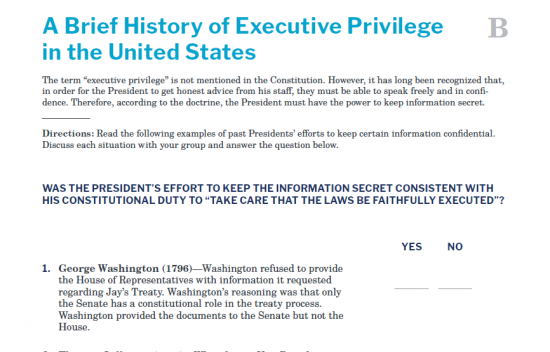
- Handout B: A Brief History of Executive Privilege in the United States
- Handout C: Herblock Watergate Cartoons
- Web Resource: Barbara Jordan’s July 25, 1974 Speech to the House Judiciary Committee Background
Lesson Components


Lesson plan
More Information
To create a context for this lesson, have students complete Constitutional Connection: Impeachment and the Constitution.
Standards
Related materials

In this lesson, students will learn how Barbara Jordan sought justice during the Watergate scandal. They will also learn how they can protect justice in their lives.

When Andrew Johnson became President upon Lincoln’s assassination, he hoped to restore the Union according to a plan that would be lenient toward the South. Lacking congressional support and political skills, Johnson found himself in a show-down with Republicans in Congress who wanted to remake the South in the image of the North, raise up blacks and poor whites, and guarantee full civil and political rights for the freedmen. This clash of goals and strategies led to the first presidential impeachment trial in our history—a test of the constitutional principles of separation of powers and checks and balances. In the end, the Founders’ mechanism of three co-equal branches of government proved strong enough to resolve the crisis.

Use this Lesson alongside The Impeachment of Andrew Johnson Decision Point to introduce students to the concept of impeachment and how it has been used throughout U.S. history.

In the highly charged partisan politics of the 1990s, President Bill Clinton’s personal indiscretions led to the second impeachment trial in our history. Independent Counsel Kenneth Starr was investigating Clinton’s pre-presidential financial dealings. In a separate case, Clinton was being sued by Paula Jones for sexual harassment. Jones called a young White House intern named Monica Lewinsky who had been having an relationship with the President to give testimony. Clinton denied the Lewinsky affair under oath in his deposition in the Jones case. This denial caught Starr’s attention, who suspected the President had committed perjury and obstructed justice. Starr assembled a grand jury and issued dozen of subpoenas, and eventually offered Lewinsky immunity in return for her testimony. When Clinton testified for Starr’s grand jury, he gave evasive answers. He ultimately admitted the Lewinsky affair to the American people that night. The House of Representatives impeached Clinton in 1998 on strict party lines, but in the Senate trial, Republicans fell far short of the two-thirds majority needed to convict.