Lesson
Rights and the New Deal
Guiding question
What is the difference between negative and positive rights? Which are protected under the Bill of Rights?

Founding Principles
Guiding Questions
- What is the difference between negative and positive rights? Which are protected under the Bill of Rights?
- How does the response to national emergencies alter the scope of government and its protection of individual rights?
- To what extend does the Constitution permit the federal government to protect/provide positive rights to its citizens?
Objectives
- Students will identify and differentiate negative and positive rights.
- Students will evaluate the potential federal government role in guaranteeing both negative and positive rights and how this role expands in times of national emergency.
- Students will recognize the tension that may occur between negative and positive rights.
Materials
Lesson Components
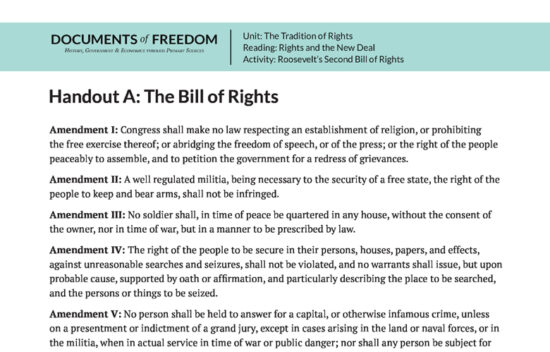
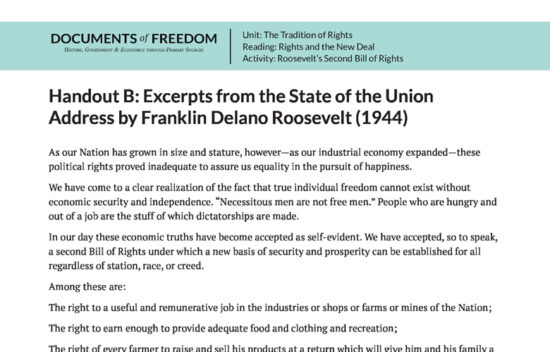
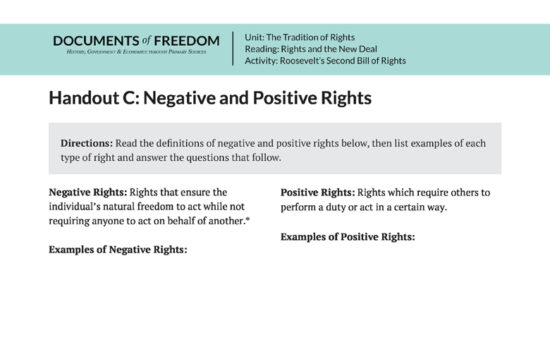
Presidents Herbert Hoover and Franklin D. Roosevelt responded to the Great Depression by asking for - and receiving - much greater powers to intervene in the economy. Congress passed hundreds of bills, created dozens of new offices and agencies, dramatically expanding the size and power of federal bureaucracy. In his 1944 State of the Union address, FDR proposed a “second bill of rights.” The “political rights” in the 1791 Bill of Rights, he argued, had “proven inadequate” for the challenges of the times. While the natural and inalienable rights in the U.S. Bill of Rights are mostly “negative” in nature, the new “rights” FDR proposed were “positive” in nature. Rather than protecting the individual’s natural liberty so he would be free to pursue happiness, FDR’s list of rights was a set of entitlements and services to be provided to certain individuals at the expense of certain others.
Lesson plan
Key Terms
- Constitution
- justice
- Bill of Rights
- liberty
- inalienable rights
Standards
Related materials

Under the New Deal, federal programs spent huge amounts of money in an attempt to combat the Great Depression. Were these programs an effective way to restore economic prosperity in the country? Glenda Gilmore and Michael Parrish debate this question.

Use this primary source imagery to analyze major events in history.

Professor Domitrovic walks through the most essential economic facts of the Progressive Era and the New Deal. Why did the government begin to expansively regulate business during this time?