Lesson
The Great Society and Beyond
Guiding question
What did the Founding Fathers think about civil and economic liberties?

Guiding Questions:
- What did the Founding Fathers think about civil and economic liberties?
- What is the current state of civic and economic liberties today?
- How did Lyndon Johnson and Ronald Reagan’s views of civic and economic liberties differ?
Objectives:
- Students shall be able to understand the Founding Fathers’ ideas of civic and economic liberty and have trace through historical documents how they have been applied.
- Evaluate the balance between civic and economic liberties and the interests of the government in the case of Citizens United v. FEC (2010)
- Compare and construct the ideologies of Ronald Reagan and Lyndon Johnson on the role of civic and economic liberties.
Materials
Student Handouts:
- The Great Society and Beyond Essay
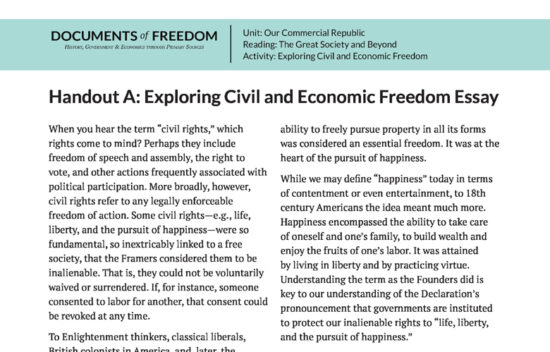
- Handout A: Exploring Civil and Economic Liberty Essay
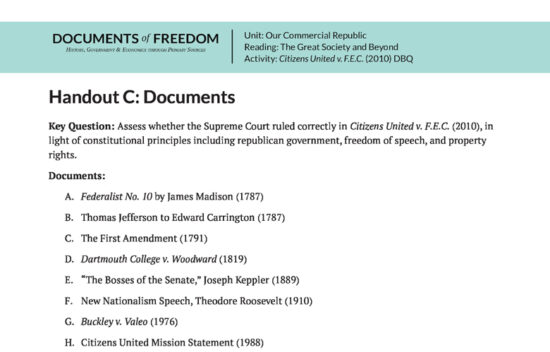
- Handout B: Citizens United v. FEC (2010) Background
- Handout C: Documents A-K
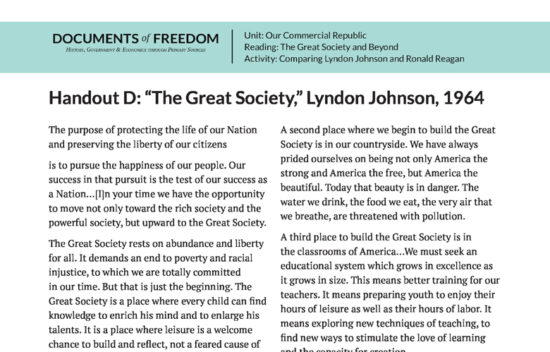
- Handout D: “The Great Society” Lyndon Johnson, 1964
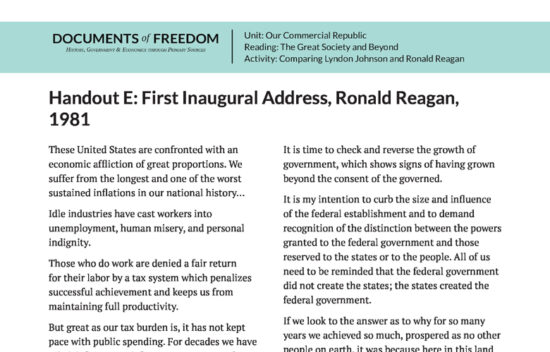
- Handout E: First Inaugural Address, Ronald Reagan, 1981
- Handout F: Articles I and II of the United States Constitution.
Lesson Components

The liberalism of the post-1960s is usually associated with cultural or “lifestyle” permissiveness, a moral relativism regarding issues of personal choice, especially sexual conduct. But it also represented the next step forward in the welfare state, concentrated in the Great Society program of 1965.
Lesson plan
Key Terms
- Liberalism
- permissiveness
- relativism
- civil liberties
- economic liberties
More Information
Depending on the grade level, students might need a pre-teaching session on the differences between economic and civic liberties. Since the discussion ends with federalism it might be worth having a discussion on the competing views of federalism and what constitutional belongs to the federal government and what constitutional belongs to the state government. It might also help to have a discussion on the various political parties’ view of the rights and or role of the federal government and the state governments.