Lesson
Understanding Prosperity Through Scarcity, Choices, and Consequences

Founding Principles
Virtues
Guiding questions
Video supplements additionally published on PolicyEd.org a product of Hoover Institution, Stanford University. To view them in their original format, click here.
Guiding Questions
- How do prosperous societies differ from unprosperous societies in addressing the issue of scarcity?
- Why are individual liberty and limited government important in expanding prosperity?
Objectives
- Students will define prosperity, scarcity, and choice.
- Students will explain how natural rights, laws, and individual actions impact prosperity.
- Students will identify the relationship that immediate choices have on life goals.
- Students will evaluate examples of choice and prosperity within a variety of governments.
Materials
Student Resources:
- Hoover Institution Videos & Viewing Guides
- Optional Student Handout
- Glossary
- Background Reading to Countries
- Background to the Jones Act of 1912, the Smoot–Hawley Tariff Act of 1930, and the North American Free Trade Agreement (NAFTA) of 1990.
Teacher Resources:
Note: The above links can also be used to support students in the analysis questions in the Explore section of this lesson. Select certain data as necessary to help illustrate the connection between free societies and economic prosperity.
Lesson Components
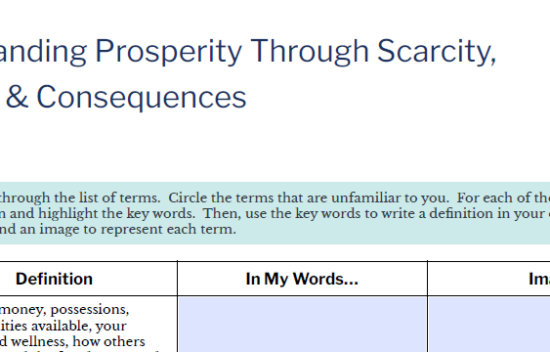


Lesson plan
Key Terms
- Prosperity
- Scarcity
- Factors of Production
- Capital
- Choice
More Information
Facilitation Notes
- Depending on the level of scaffolding needed for your students, consider distributing the video viewing guides for added support.
- When discussing “time” as a scarce resource, note that everyone has the same number of hours in a week (168). The fact that time is limited makes it scarce. Good “time-management” is helpful but cannot increase the number of hours in a week.
- When discussing “jobs” for the “consequences of the scarcity of oil,” ensure students understand the process of “creative destruction.” Economist Joseph Schumpeter argued that a healthy economy actually destroys jobs, by creating new jobs that make less efficient jobs obsolete. When looking at the assignments under “Assess and Reflect,” use your best judgment as to what best suits your students. You have an option to assign both the “self-reflection” and the “societal reflection,” or just one based on the needs and make-up of your class.
Standards
Related materials
How do prosperous societies differ from unprosperous societies in addressing the issue of scarcity? Why are individual liberty and limited government important in expanding prosperity?
How do prices reflect scarcity? How do prices impact prosperity in society? How does cooperation help mitigate scarcity?

How does trade increase individual and societal prosperity? How has the world made economic progress in the past few centuries? What does it mean to prosper individually versus living in a prosperous society?

Why is equality important for achieving prosperity? How does rule of law create a stable and predictable environment for economic prosperity? What is the proper role of the government in regulating the economy?

How does free speech impact economic prosperity? How does a marketplace of ideas support prosperity?

What does it mean to live a prosperous life? What role do social safety nets play in a prosperous society? How do people rise out of poverty in prosperous societies?

Why is individual liberty crucial for prosperity? What is the role of the individual, government, and the economy in the creation and maintenance of a free society? Use the lesson and videos to answer these questions with your students.