Lesson
Women’s Rights in the Late 20th Century

Guiding Questions
- Support or refute the Supreme Court’s ruling in Griswold v. Connecticut (1965) that the Constitution protects a right to privacy within marriage that includes the decision to use artificial birth control.
Objectives
- Students will trace some of the significant events regarding women’s rights in the twentieth century, considering court cases and women’s social and economic contributions.
Materials
Educator Resources
Student Handouts
- Women’s Rights in the Late 20th Century Essay
- Handout A: The U.S. Constitution
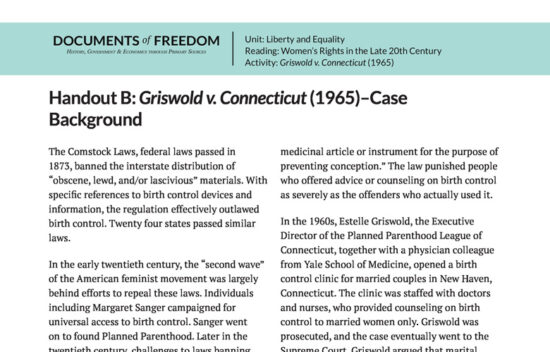
- Handout B: Griswold v. Connecticut (1965) Case Background
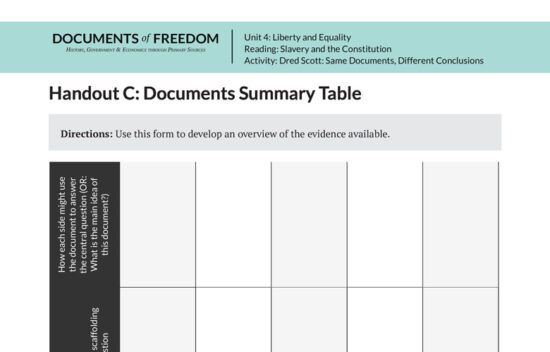
- Handout C: Document Summary Table
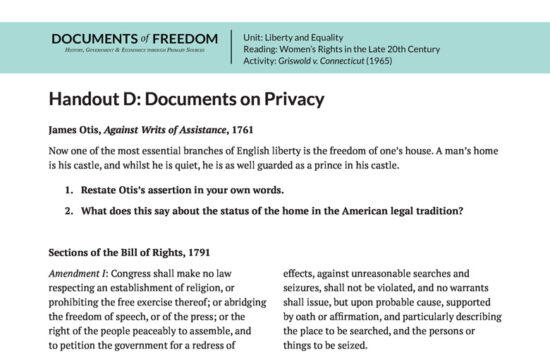
- Handout D: Documents on Privacy
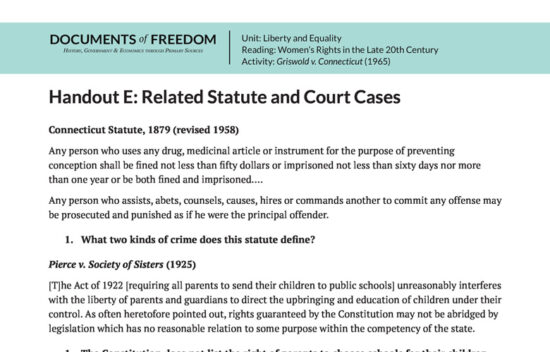
- Handout E: Related Statute and Court Cases
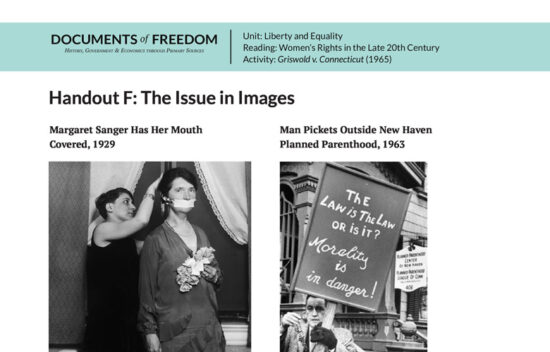
- Handout F: The Issue in Images
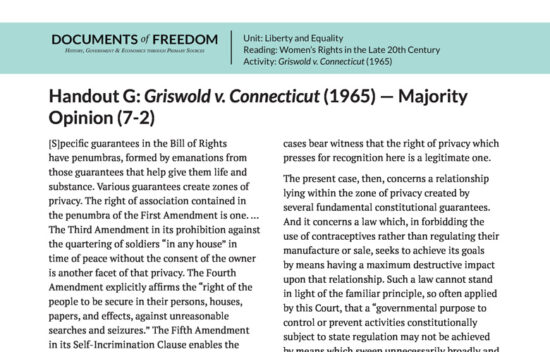
- Handout G: Griswold v. Connecticut Majority Opinion Excerpts
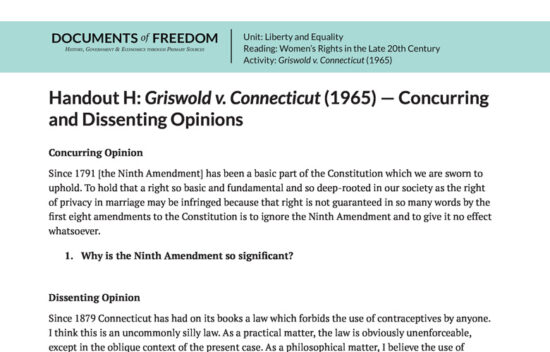
- Handout H: Griswold v. Connecticut Concurring and Dissenting Opinions Excerpts
Lesson Components

After World War II, women’s struggle for equality achieved a mixed record of success. The women’s rights movement won equal opportunities in higher education and employment relatively quickly in the 1940s and 1950s. The modern concept of women’s equality as “feminism” appeared in the 1960s, led by activists such as Betty Friedan. Some of its victories in the legislative arena were completely inadvertent, while one of its grandest objects and subject of its greatest efforts resulted in defeat. Moreover, the movement was dominated by an intellectual and professional leadership at some distance from ordinary women. Despite the vagaries of the movement, it was remarkably successful in fundamentally changing society and women’s roles as well as attitudes towards women.
Lesson plan
Key Terms
- equality
- Fourteenth Amendment
- Justice
- Ninth Amendment
- Bill of Rights
More Information
To support students prior to beginning their analysis, the teacher will ask, “What are the two sides? What did each side want? How did each side interpret the Constitution differently? How might different interpretations of specific, critical phrases lead to different conclusions?
Standards
Related materials

Use this primary source text to explore key historical events.