Lesson
Colonial Experience with Government and Economics

Founding Principles
Guiding Questions
- How did the experience of colonists lead to an expanded interpretation of “property of every sort,” including physical possessions, rights of conscience, and more?
- What is the relationship between one’s rights concerning physical possessions and rights of conscience?
Objectives
- Students will trace historical developments that led to expanded individual liberty in colonial America.
- Students will evaluate the relationship between rights concerning physical property and rights of conscience.
Materials
Educator Resources
- Handout A: Excerpts from the Massachusetts Body of Liberties Answer Key
- Handout B: Memorial and Remonstrance Answer Key
Student Handouts
Lesson Components
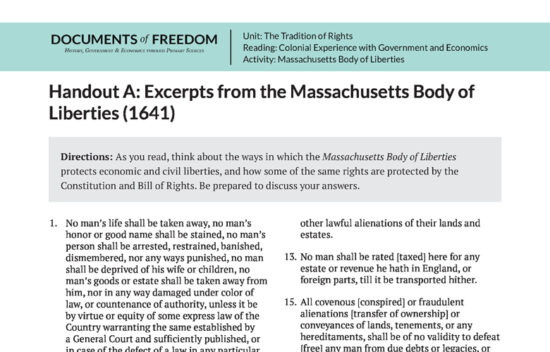
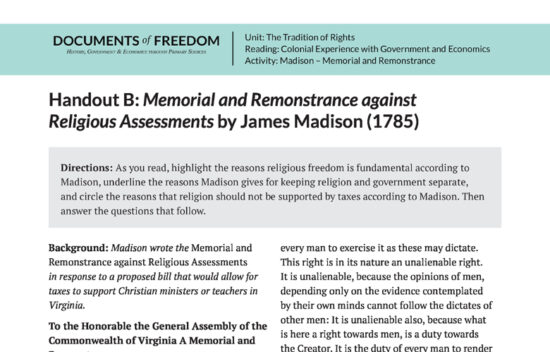
When European colonists came to North America, they faced the challenge of establishing societies that reflected their identity and mission for God. Experiments with economic and civil liberty followed in the name of the common good. Colonists and, later, the Founding generation became convinced that legally requiring individuals to commit their labor or their money towards a communal farm or church, with no regard for individual contribution or conscience, violated principles of justice. The link between economic liberty and the liberty of conscience became clear to many, and is responsible for liberating "a field without an horizon ... to the exploring and ardent curiosity of man."
Lesson plan
Key Terms
- Thomas Jefferson
- justice
- inalienable rights
- Founders
- Alexis de Tocqueville
Standards
Related materials

America's Founders looked to the lessons of human nature and history to determine how best to structure a government that would promote liberty. They started with the principle of consent of the governed: the only legitimate government is one which the people themselves have authorized. But the Founders also guarded against the tendency of those in power to abuse their authority, and structured a government whose power is limited and divided in complex ways to prevent a concentration of power. They counted on citizens to live out virtues like justice, honesty, respect, humility, and responsibility.

Rights claims have always been central to American political discourse. In the Founders' view, no human being is so decisively superior to other adult human beings that he is entitled to direct their actions without their express consent. By Nature all adult human beings, regardless of their race, sex or class, are free to rule themselves or, what is the same, to exercise the same "inalienable rights," including the right to life, physical liberty, acquire and use property, marry and raise children, communicate one's opinions, and worship God according to the dictates of one's conscience.